TL;DR

Get furniture and decor delivered free with Prime
- Fast, free delivery on millions of items
- Prime Video, Amazon Music and more included
- Member-only deals all year
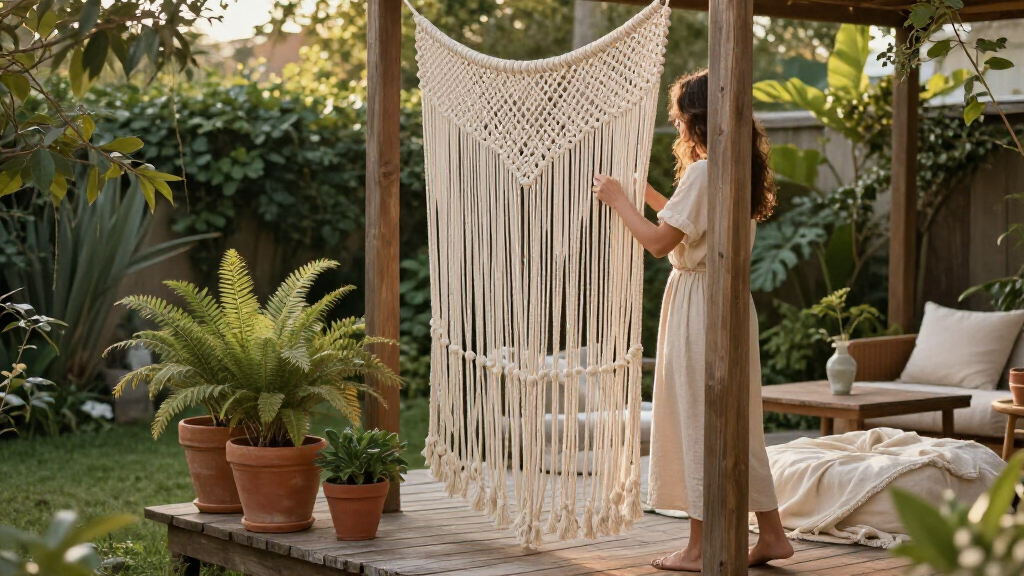
Hunker has outlined a boho-inspired way to add some privacy to a yard or patio without installing a conventional fence: a DIY macrame screen hung from a sturdy support. The report suggests about 200 yards of synthetic or weather-treated cord for a 2-by-5-foot panel, but the finished screen’s durability, privacy level and suitability for particular outdoor conditions are not specified.
Hunker has described a DIY macrame screen as an option for adding partial privacy to a yard or patio without putting up a traditional fence. The idea uses woven cord hung from a rod, pergola or other support, giving homeowners a customizable divider; the report does not establish how much privacy or weather resistance a finished screen provides.
The project is presented as a beginner-friendly, budget-conscious DIY, though the cost will depend on the cord, support and hardware chosen. Hunker estimates about 200 yards of synthetic or weather-treated fabric for each panel measuring 2 by 5 feet. The material is attached to a wooden or metal support, such as a curtain rod or pergola, using hardware strong enough to carry the finished screen.
For the method described, makers measure the intended panel length, cut strands at twice that length, fold each strand in half and attach it to the top bar with a lark’s head knot. They then weave rows in a selected pattern. Hunker advises buying extra cord because the quantity depends on the design and structure, and says unused material may be easier to return than matching a later purchase.
The screen can be adapted with beads, different knot patterns or integrated plant hangers, according to the report. Other options include placing planters at the base or attaching macrame to a folding divider frame that can be moved. Hunker says a frame used outdoors may need weatherproofing, but does not provide a specific treatment or product recommendation.
A Flexible Screen, Not a Solid Fence
A hanging macrame panel may suit people who want to mark off a patio or seating area without committing to a conventional fence. Its visual texture and customizable pattern make it a decorative feature as well as a divider, and a movable frame could let users reposition it as their needs change.
That flexibility comes with limits. The source describes a way to create a screen, not a secure boundary or a guaranteed barrier against views. Privacy will depend on the pattern, spacing and placement, and the report offers no measurements or tests of how much sightline coverage different designs provide. Anyone seeking substantial screening should assess the finished weave from nearby viewpoints before relying on it.
Support and upkeep also matter. A long panel adds weight to its rod or frame, while outdoor exposure can affect the cord and fittings. Readers should check that the support and attachments are suited to the intended installation and local conditions. Hunker’s material estimate is a project guide, not a guarantee that a particular screen will perform safely or last a set period.
outdoor macrame privacy screen kit
As an affiliate, we earn on qualifying purchases.
As an affiliate, we earn on qualifying purchases.
How the DIY Screen Is Made
Macrame is a knotting technique with a long history. Hunker traces its origins to the 13th century and describes it as both decorative and functional. The report applies that technique to outdoor privacy, rather than proposing a new type of fencing or a tested commercial product.
Its instructions leave room for different builds: a fixed panel can hang from a rod or pergola, while a folding divider can be moved. The source points readers to patterns, including examples associated with blogger Rachel of A Beautiful Mess and creator Deepa Rai, but gives no specific pattern dimensions or independent evaluation of those examples. The practical details—cord length, mounting method and weather protection—will vary with the chosen design.
““about 200 yards of synthetic or weather-treated fabric per 2-by-5-foot panel””
— Hunker
Coverage and Outdoor Durability
The report does not specify how opaque a macrame panel will be, how much wind or rain it can withstand, or how long a particular cord will last outside. It also does not give tested load limits for rods, hooks, brackets or frames. Those results will depend on materials, knots, dimensions and installation, so the suggested quantities should not be treated as performance guarantees.
Local rules may also affect outdoor structures or changes to a property, but Hunker’s report does not discuss permits, rental restrictions or neighborhood requirements. It is not clear whether its proposed designs meet any particular local standard. Readers should check applicable requirements and use supports and materials suitable for their site before building.
Plan the Site Before Building
Anyone considering the project can start by measuring the area and deciding whether the screen will be fixed or movable. They can then choose a pattern, estimate cord needs and select a support and fasteners rated for the intended use. Testing the pattern in place can help show whether it provides enough visual screening before the full panel is completed.
For a permanent outdoor installation, homeowners should check local rules and the support structure’s capacity, and account for weather exposure and maintenance. Hunker’s report does not announce a product launch or follow-up testing; the next steps are practical decisions left to the person building the screen.
Key Questions
How much cord does one panel require?
Hunker estimates about 200 yards of synthetic or weather-treated material for a 2-by-5-foot panel. The amount can vary with the knot pattern and construction, so the figure is a guide rather than a fixed requirement.
Does a macrame screen provide full privacy?
The source does not claim that it provides full privacy. Coverage depends on the weave, spacing and viewing angle; check the finished pattern from the places where privacy is needed.
Can the screen stay outside?
Hunker recommends synthetic or weather-treated material and says an outdoor folding frame may need weatherproofing. It does not give durability tests or a specific treatment, so outdoor performance will depend on the materials and conditions.
What can support the panel?
The report lists a curtain rod, pergola or another wooden or metal support, secured with strong hardware such as hooks or brackets. The support and fasteners should be appropriate for the finished panel’s weight and the installation site.
Is this a replacement for a boundary fence?
The article presents macrame as a decorative privacy divider, not as a secure or code-compliant boundary. Check local rules and choose a different solution if you need a defined property boundary or a substantial barrier.
Source: rss
Halloween Picks
halloween
As an affiliate, we earn on qualifying purchases.