Choosing a commercial burr coffee grinder from this group means balancing workflow features against an important limitation: these are home-oriented grinders, not documented café-duty machines. For the most adaptable dosing setup, I’d start with the Tuni G3, which pairs a large hopper with single-dose parts and timed modes. The MOKKOM BD-CG308 is a strong alternative for buyers who want two hopper styles and easier access for cleaning, while the SHARDOR CG301 offers fine timer adjustments and removable components in a more straightforward package.

Get furniture and decor delivered free with Prime
- Fast, free delivery on millions of items
- Prime Video, Amazon Music and more included
- Member-only deals all year
All five use 64mm flat burrs and offer many grind adjustments, but their practical differences matter more than the headline setting count. I compare portafilter fit, dosing controls, hopper flexibility, cleaning access, and electrical compatibility. The tradeoff is clear: these models provide useful café-style workflow features for a home, office, or light-use coffee bar, but the supplied specifications do not establish commercial throughput or continuous-duty performance. I would choose based on the workload you can verify, not on the word “commercial” alone.
Complete the kit


Key Takeaways
- Tuni G3 is the most flexible pick for switching between hopper-fed batches and single-dose grinding; check the adjustment wording if package documentation matters to you.
- MOKKOM BD-CG308 combines a 350g hopper, a single-dose hopper, and a removable upper burr, but it is specified for 120V.
- SHARDOR CG301 provides 0.1-second timer increments and removable cleaning parts; a single-dose hopper is sold separately.
- AMZCHEF FC6202 has a 0.1-second timer and 58mm-focused accessories, making portafilter size compatibility a deciding factor.
- SHARDOR CG305B has a large 17.6-ounce hopper and programmable shot dosing, but its 11.4-pound weight and 120V specification limit portability.
| Tuni G3 64mm Flat Burr Coffee Grinder, 100 Grind Settings, Ivory |  | Best Overall for Flexible Dosing | Burrs: 64mm stainless steel flat burrs | Grind adjustment: 100 settings; described as stepless | Hopper options: 250g large hopper; 50g single-dose hopper | VIEW ON AMAZON | See Our Full Breakdown |
| MOKKOM 64mm Flat Burr Coffee Grinder with 100 Grind Settings |  | Best for Hopper Choice and Cleaning Access | Burrs: 64mm stainless steel flat burrs | Grind settings: 100 | Main hopper: 350g / 12.35oz | VIEW ON AMAZON | See Our Full Breakdown |
| SHARDOR 64mm Flat Burr Coffee Grinder with 100 Settings | 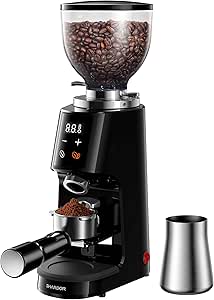 | Best for Fine Timer Control and Cleaning | Burr size: 64mm flat burrs | Grind settings: 100 | Hopper capacity: 250g | VIEW ON AMAZON | See Our Full Breakdown |
| SHARDOR 64mm Electric Burr Coffee Grinder with 100 Grind Settings |  | Best for Large Hopper and Programmed Shot Dosing | Burrs: 64mm SUS420 stainless steel flat burrs | Grind settings: 100 | Hopper capacity: 17.6oz | VIEW ON AMAZON | See Our Full Breakdown |
| AMZCHEF 64mm Flat Burr Coffee Grinder with 90 Grind Settings |  | Best for 58mm Portafilter Workflows | Burrs: 64mm stainless steel flat burrs | Grind settings: 90 | Timer precision: 0.1-second increments | VIEW ON AMAZON | See Our Full Breakdown |
| commercial burr coffee grinder | Power | Burrs | Grind settings |
|---|---|---|---|
| Tuni G3 64mm Flat Burr Coffee | AC adapter | 64mm stainless steel flat burrs | — |
| MOKKOM 64mm Flat Burr Coffee G | 260W; 120V | 64mm stainless steel flat burrs | 100 |
| SHARDOR 64mm Flat Burr Coffee | 260W; 120V | — | 100 |
| SHARDOR 64mm Electric Burr Cof | 350W; 120V | 64mm SUS420 stainless steel flat burrs | 100 |
| AMZCHEF 64mm Flat Burr Coffee | 200W; 120V AC | 64mm stainless steel flat burrs | 90 |
More Details on Our Top Picks
Tuni G3 64mm Flat Burr Coffee Grinder, 100 Grind Settings, Ivory
The Tuni G3 takes the top position because it is the most adaptable setup in this lineup. Its 250g hopper supports a ready-to-grind station, while the included 50g single-dose hopper lets an operator switch to weighing each batch without buying another hopper. That combination is more useful for mixed menus than a large hopper alone, such as the SHARDOR CG305B’s 17.6-ounce capacity.
Its touchscreen offers single, double, and continuous modes, and grind time moves in 0.5-second increments. That is less granular than the 0.1-second controls on the AMZCHEF and two other models, but timed modes and a supplied dosing cup, ring, and portafilter holder create a more complete out-of-box workflow. Anti-static technology is also specified to help limit scattered grounds around a busy counter.
The main caution is documentation: the packaging reportedly uses outdated wording that describes the adjustment as non-stepless, while the supplied specification says it is stepless. I would confirm the adjustment mechanism with the seller if fine dialing-in is central to the purchase. Like the rest of this selection, the Tuni’s features do not prove it can handle sustained café volume; I’d treat it as the strongest flexible choice for lower-volume service or a serious home station, not a guaranteed commercial workhorse.
Pros:- Includes large and single-dose hoppers for two distinct workflows.
- Timed single, double, and continuous grind modes.
- Anti-static system and dosing accessories support a tidier station.
- Portafilter holder is listed for 51–58mm handles.
Cons:- Timer changes in 0.5-second increments, less precise than several rivals.
- Reported packaging text conflicts with the stated stepless adjustment.
Best for: Buyers who want both hopper-fed grinding and single-dose flexibility, plus direct portafilter dosing accessories.
Not ideal for: High-volume cafés needing documented duty-cycle or throughput data, or buyers who require fine 0.1-second timer increments.
- Burrs:64mm stainless steel flat burrs
- Grind adjustment:100 settings; described as stepless
- Hopper options:250g large hopper; 50g single-dose hopper
- Controls:LED touchscreen; single, double, and continuous modes
- Timer increments:0.5 seconds
- Portafilter fit:51–58mm
- Power:AC adapter
- Support:One-year warranty; lifetime technical support
Our verdict“I rank the Tuni G3 first for its unusually flexible included workflow, while advising buyers to verify the adjustment details and commercial workload limits.”
MOKKOM 64mm Flat Burr Coffee Grinder with 100 Grind Settings
MOKKOM earns second place by pairing a 350g main hopper with a dedicated single-dose hopper, then adding a removable upper burr to make cleaning more accessible. For a station that alternates between keeping beans loaded and grinding measured portions, this is a more versatile arrangement than the SHARDOR CG301, whose single-dose hopper is sold separately. Its 0.1-second timer increments also give finer time adjustments than the Tuni G3’s half-second steps.
The stainless steel body and anti-static plasma generator are aimed at a cleaner, sturdy-feeling workflow, while the listed 100 settings cover a broad range from Turkish coffee through cold brew. Still, a setting count alone says little about the quality of adjustment or actual output. The product details do not state a commercial duty cycle, and 120V power makes regional compatibility a real purchase check. I would not assume it is suitable for a 220V supply.
Compared with the Tuni, MOKKOM offers a larger main hopper and finer timer increments, but the Tuni lists more explicit timed modes and portafilter compatibility. MOKKOM makes better sense if hopper flexibility and cleaning access are the priorities; it is less compelling for buyers who need confirmed business-grade endurance or broad voltage support.
Pros:- Includes 350g main and single-dose hoppers.
- Removable upper burr simplifies access for cleaning.
- 0.1-second timer increments allow fine timed adjustments.
- Anti-static plasma generator is designed to reduce scattered grounds.
Cons:- Listed for 120V, restricting compatibility in some regions.
- No duty-cycle or commercial throughput data is supplied.
Best for: Buyers who want a large hopper, a separate single-dose option, and easier access for routine cleaning.
Not ideal for: Operators outside 120V regions or commercial buyers who need published continuous-duty specifications.
- Burrs:64mm stainless steel flat burrs
- Grind settings:100
- Main hopper:350g / 12.35oz
- Included hoppers:Large hopper and single-dose hopper
- Timer precision:0.1-second increments
- Body:Stainless steel
- Power:260W; 120V
- Model:BD-CG308
Our verdict“I’d choose MOKKOM over the Tuni for its larger hopper and cleaning access, provided 120V power and unverified commercial capacity fit the plan.”
SHARDOR 64mm Flat Burr Coffee Grinder with 100 Settings
The SHARDOR CG301 is a practical pick for buyers who value repeatable timing and accessible cleaning over multiple hopper options. Its display adjusts grind time in 0.1-second increments, and its removable components make routine cleanup easier than on a grinder whose parts are less explicitly described as removable. The all-metal grinding chamber, stainless steel cup, grounds duster, and portafilter holder also give it a useful set of included station accessories.
Against the Tuni G3, the CG301 has finer timer steps but gives up the included single-dose hopper and its choice of timed single, double, and continuous modes. Compared with MOKKOM, it offers similar timer precision but has a smaller stated capacity of 250g and requires a separate purchase for a single-dose hopper. These distinctions make it a more focused grinder for someone who keeps one basic workflow and wants to clean the grinder without disassembling a complicated setup.
The listed 120V-only requirement is a firm limitation, with the product details warning that 220V use can damage the grinder. Buyers should confirm the supply before ordering, especially for a shared workplace or a location outside North America. The supplied information also does not establish café-level duty performance, so I would reserve it for home, office, or modest service demands rather than assuming it can grind continuously through a rush.
Pros:- Timer settings adjust in 0.1-second increments.
- Removable parts support routine cleaning.
- Includes a stainless steel cup, portafilter holder, and cleaning accessories.
- 100 grind settings span multiple brew styles.
Cons:- Designed for 120V; 220V use can damage the grinder.
- Single-dose hopper is sold separately.
- No commercial duty-cycle information is provided.
Best for: Buyers who want precise timer increments, removable cleaning parts, and a straightforward 250g hopper workflow.
Not ideal for: Those needing a supplied single-dose hopper, international voltage flexibility, or verified high-volume service capacity.
- Burr size:64mm flat burrs
- Grind settings:100
- Hopper capacity:250g
- Grinding chamber:All-metal
- Timer adjustment:0.1-second increments
- Power:260W; 120V
- Dimensions:8.15 × 5.2 × 15.28in
- Included accessories:Portafilter holder, stainless steel cup, brush, duster, spanner, and trap door
Our verdict“I recommend the CG301 for a fixed, modest-volume workflow where timer precision and cleaning access matter more than included hopper flexibility.”
SHARDOR 64mm Electric Burr Coffee Grinder with 100 Grind Settings
The SHARDOR CG305B suits a station that keeps beans loaded and wants programmable single- and double-shot dosing. Its 17.6-ounce hopper is the largest clearly stated capacity in this group, ahead of the Tuni’s 250g hopper and the MOKKOM’s 350g option. That can reduce the need to refill during a steady but modest workflow. An adjustable portafilter holder, manual override, anti-static system, and stainless steel grounds container round out a setup designed around direct grinding.
There is a noticeable difference between this grinder and the more flexible Tuni or MOKKOM: the CG305B’s listed features center on hopper-fed dosing, not an included single-dose hopper. Its 11.4-pound weight also makes it the heaviest model here by stated weight, which is less appealing if the grinder needs to move between stations. The aluminum housing and chamber are substantial listed construction details, but the supplied information does not say how much continuous grinding the motor can sustain.
The 120V specification further narrows where it fits. I would favor it over the AMZCHEF if larger hopper capacity and programmed shot controls matter more than a fine 0.1-second timer or 58mm-specific accessories. Buyers should skip it if they need flexible voltage, a compact footprint, or evidence of performance under sustained commercial service.
Pros:- 17.6-ounce hopper supports longer stretches between refills.
- Programmable single- and double-shot dosing with manual override.
- Adjustable portafilter holder fits most standard handles.
- Anti-static system and stainless steel grounds container support cleaner dosing.
Cons:- Weighs 11.4 pounds, making it less convenient to move.
- Designed for 120V power.
- No single-dose hopper or published duty-cycle data is listed.
Best for: A 120V station that wants a large bean hopper, programmed single- and double-shot grinding, and an adjustable holder.
Not ideal for: Buyers who need a lightweight grinder, single-dose hopper, international voltage support, or documented café duty capability.
- Burrs:64mm SUS420 stainless steel flat burrs
- Grind settings:100
- Hopper capacity:17.6oz
- Controls:LED touchscreen; single and double dosing; manual override
- Housing and chamber:Die-cast aluminum housing and aluminum grinding chamber
- Power:350W; 120V
- Weight:11.4lb
- Grounds container:Stainless steel
Our verdict“I’d choose the CG305B for hopper capacity and programmed shot dosing, but not for portability or unverified high-volume café use.”
AMZCHEF 64mm Flat Burr Coffee Grinder with 90 Grind Settings
AMZCHEF is the most specialized choice in this ranking: it combines a 58mm portafilter holder, magnetic dosing cup, and timer adjustments in 0.1-second increments. That makes it an appealing fit for buyers whose espresso setup already uses a compatible 58mm portafilter and who want measured, direct dosing. Its 90 grind settings are fewer than the 100 listed by the other four models, but that difference matters less than whether the grind range suits the coffees and brew methods actually used.
Compared with the SHARDOR CG305B, AMZCHEF gives up hopper capacity and programmed single/double shot modes, but offers finer timer increments and a more specifically stated 58mm accessory fit. Its stated 9.88-ounce capacity is also below the larger hoppers from SHARDOR and MOKKOM. The magnetic dosing cup and anti-static features may help contain grounds, though the included accessories are modest: a cleaning brush and cup are listed, and the portafilter is sold separately.
This is also the strictest fit limitation in the lineup. The holder and cup are designed only for 58mm portafilters, unlike the Tuni’s listed 51–58mm compatibility or SHARDOR’s adjustable holder. Its 120V AC power and 12-pound weight make it less flexible as a shared or mobile grinder. I’d place it last not because its workflow lacks purpose, but because that purpose is narrow and the supplied description offers less hopper capacity and fewer programmed controls than several alternatives.
Pros:- 0.1-second timer increments support fine timed dosing adjustments.
- Magnetic dosing cup and anti-static features are intended to reduce mess.
- Includes a 58mm portafilter holder and cleaning brush.
- 90 settings cover espresso through French press and cold brew.
Cons:- Portafilter is not included; holder and cup are limited to 58mm.
- Capacity is smaller than the listed hoppers on several competing models.
- Specified for 120V and has no published commercial duty-cycle data.
Best for: Espresso users with a 58mm portafilter who prioritize precise timer adjustments and a magnetic dosing cup.
Not ideal for: Owners of other portafilter sizes, buyers seeking a large hopper, or operators who need verified commercial throughput.
- Burrs:64mm stainless steel flat burrs
- Grind settings:90
- Timer precision:0.1-second increments
- Portafilter fit:58mm only
- Capacity:9.88oz
- Body:Stainless steel
- Power:200W; 120V AC
- Weight:12lb
Our verdict“I’d select AMZCHEF only when its 58mm fit and precise timer match the espresso workflow; otherwise, the more adaptable alternatives rank higher.”

How We Picked
I ranked these grinders by how well their stated features support a repeatable, practical coffee workflow, rather than treating a large grind-setting count as proof of commercial readiness. All five list 64mm flat burrs, so I gave more weight to distinctions buyers can act on: hopper choices, timer precision, programmed dosing, portafilter compatibility, cleaning access, and stated electrical requirements.
I also separated useful specifications from claims the supplied information cannot substantiate. None of these descriptions gives a commercial duty cycle, hourly output, service interval, or grinder certification for sustained café operation. That prevents me from presenting any as a proven high-volume café grinder. My order instead favors adaptable workflow and accessories first, then increasingly specialized or constrained choices. Buyers planning regular service should verify capacity, warranty coverage for business use, and local voltage with the manufacturer before purchasing.
Factors to Consider When Choosing Commercial Burr Coffee Grinder
I’d choose a grinder by matching its workflow to the actual service pattern, then checking whether the product’s stated limits fit the location. The 64mm burr size and broad grind ranges are common across this group; they do not, by themselves, establish commercial durability.Match the grinder to the workload
For a home espresso bar, office, or light-use coffee station, timed dosing and a practical hopper may be enough. For a café serving repeated orders through a rush, I would ask the manufacturer for duty-cycle and throughput information before treating any grinder here as a commercial machine. The listings supplied do not give those figures, nor do they describe service intervals or business-use warranty terms. That gap matters more than whether a model lists 90 or 100 settings.
Choose hopper-fed or single-dose grinding
A large hopper keeps beans ready and can reduce interruptions, which favors the SHARDOR CG305B and MOKKOM. Single-dose grinding gives the operator more control over each measured batch and can suit rotating coffees; Tuni and MOKKOM include a separate single-dose hopper, while the SHARDOR CG301 requires one to be purchased separately. I’d decide which workflow will be used most often rather than paying attention to capacity alone.
Read dosing controls as workflow features
Programmable shot buttons can make repeated portions easier, as on the SHARDOR CG305B, while the Tuni lists single, double, and continuous modes. Timer increments of 0.1 seconds on the AMZCHEF, MOKKOM, and CG301 offer finer adjustment than the Tuni’s 0.5-second steps. Timer precision can help tune a dose, but it does not prove that every grind will weigh identically: bean type, grind setting, and retention can affect the dose. A scale remains useful when dose accuracy matters.
Check portafilter compatibility before buying
Direct-to-portafilter grinding is convenient only when the holder fits securely. The Tuni lists compatibility from 51 to 58mm, and the CG305B has an adjustable holder for most standard handles. AMZCHEF’s holder is specified for 58mm portafilters only, and its portafilter is not included. If the grinder will serve different espresso machines, a broader or adjustable fit may be more useful than a narrowly tailored holder.
Treat voltage and cleaning as practical constraints
Several models are specified for 120V; SHARDOR CG301 explicitly warns that 220V can damage the unit, and the other 120V listings also need a compatible supply. I would not rely on a plug adapter to change voltage. For upkeep, MOKKOM lists a removable upper burr and SHARDOR CG301 describes removable parts; these details can make routine cleaning more accessible. Confirm the manufacturer’s cleaning instructions and parts availability if the grinder will see frequent use.
Frequently Asked Questions
Are these grinders suitable for a busy commercial café?
The supplied product details do not establish that any model is rated for sustained café duty. They omit documented hourly output, duty cycles, and service intervals. I would treat them as home, office, or light-use station candidates until the manufacturer confirms business-use suitability and warranty coverage for the intended workload.
Which grinder offers the most flexible hopper setup?
The Tuni G3 and MOKKOM BD-CG308 both include a large hopper and a single-dose hopper. Tuni lists a 250g main hopper and a 50g single-dose hopper, while MOKKOM lists a 350g main hopper plus a single-dose option. The SHARDOR CG301 can add a single-dose hopper, but it is sold separately.
Does 100 grind settings mean a grinder is better?
Not by itself. Four models list 100 settings and AMZCHEF lists 90, but the number does not describe adjustment quality, grind consistency, durability, or café output. I’d give more weight to whether the adjustment range suits your brewing methods, whether the workflow fits your station, and whether the machine is rated for the workload.
Which models have the finest listed timer increments?
AMZCHEF, MOKKOM, and SHARDOR CG301 list 0.1-second timer increments. The Tuni G3 lists 0.5-second increments, while the SHARDOR CG305B description does not specify an increment size. Fine timer steps help tune timed grinding, but a scale is still the safer way to check dose weight.
What should I check before using one outside a 120V region?
Confirm the grinder’s voltage and frequency requirements with the manufacturer before connecting it to a local supply. The MOKKOM and both SHARDOR listings in this lineup specify 120V, and the CG301 warns that 220V can damage the unit. A plug adapter changes the plug shape, not the supply voltage, so I would not use one as a substitute for proper electrical compatibility.
Conclusion
For the broadest included workflow, I’d choose the Tuni G3, especially when a station alternates between hopper-fed grinding and single doses. Choose MOKKOM if its larger hopper and removable upper burr better match your routine, and the SHARDOR CG301 if fine timer increments and cleaning access are priorities. The CG305B makes sense for a 120V station that values a large hopper and programmed shot dosing, while AMZCHEF is the focused option for a compatible 58mm portafilter setup. For any high-volume café, I’d pause before buying and get written confirmation of duty cycle, throughput, service support, and business-use coverage. These are feature-rich grinders, but the available specifications do not establish them as proven commercial-duty machines.
Halloween Picks
halloween
As an affiliate, we earn on qualifying purchases.