
TL;DR

Get furniture and decor delivered free with Prime
- Fast, free delivery on millions of items
- Prime Video, Amazon Music and more included
- Member-only deals all year
Meissen Blue Onion, a blue-and-white porcelain pattern developed in the 18th century, remains a sought-after thrift and antique-market find. A source report gives listed prices ranging from hundreds of dollars for some individual pieces to nearly $3,000 for an estate-sized set on the replacement market; actual value depends on the piece and its condition.
Meissen’s Blue Onion porcelain, an 18th-century blue-and-white pattern still made by the German manufacturer, can sell for hundreds of dollars per piece, according to a Hunker report on thrifted china. The report says a complete estate-sized set could approach $3,000 on the replacement market, though the price depends on condition, rarity, marks and completeness, and listed prices do not establish what a seller will receive.
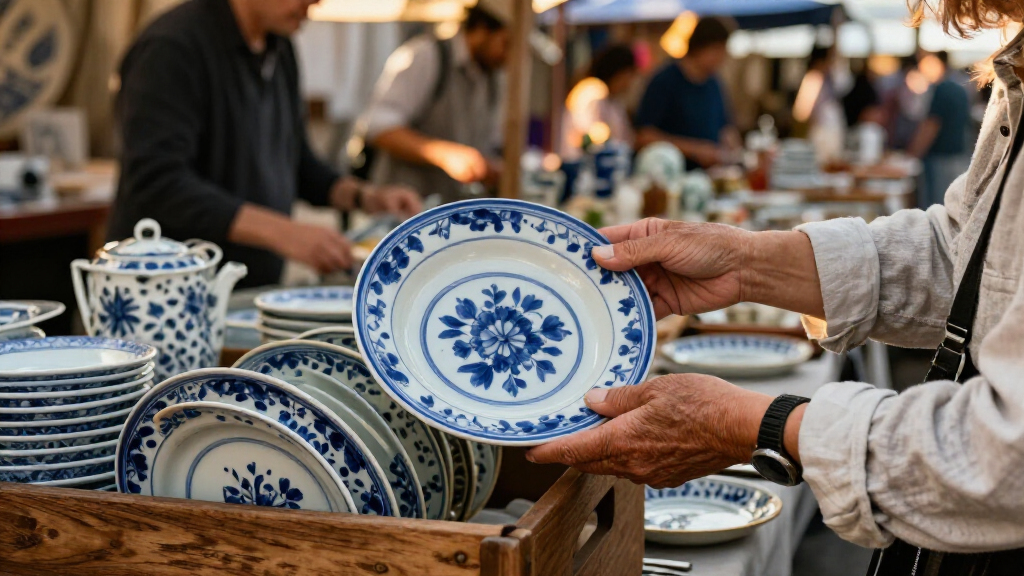
The pattern is associated with Meissen, a porcelain maker founded in Saxony, now part of Germany. Hunker traces its origins to around 1739, when Meissen artist Johann Gregor Höroldt adapted Chinese design motifs into blue underglaze decoration. The resulting pattern appears on many forms, including plates, cups, bowls and serving pieces.
The report cites retail or online asking prices of $200 to $500 for single plates, a $615 listing for a square bowl, and an Etsy listing of nearly $800 for a table set for six. It also cites an hors d’oeuvre set estimated at $850 on Chairish. These are examples of listings, not verified completed-sale prices or guarantees of what a particular piece is worth.
For identification, Hunker says authentic Meissen pieces carry the factory’s crossed-swords mark. It contrasts these with Blue Danube, a similar Japanese-made pattern that the report says is labeled “Blue Danube” in a blue rectangle alongside “Japan.” Buyers should inspect the underside and consider the mark alongside the pattern, age and condition rather than relying on appearance alone.
How Marks Affect a China Find
For people sorting through estate sales, flea markets or thrift-store shelves, Blue Onion illustrates why a familiar-looking plate can merit closer inspection. If a piece is correctly identified and in desirable condition, it may have a higher resale or replacement value than ordinary secondhand dinnerware. The maker’s mark offers a practical starting point for distinguishing Meissen from a similar design, but it does not by itself establish a final price.
Collectors and sellers also need to account for condition, rarity, size and set completeness. A damaged single plate and a well-preserved group of serving pieces are not equivalent finds. The figures in the report show a wide range of asking prices, while actual offers may differ by location, demand and the details of each item.
Products Worth Considering

Philips Hue Essential Starter Kit with Bridge and 4 E26 Smart Bulbs

Philips Hue Secure Starter Kit with Contact Sensors, Motion Sensor, Bridge, and Color Smart Bulbs

Coway Airmega AP-1512HHS Smart HEPA Air Purifier, Black
As an affiliate, we earn on qualifying purchases.
From Saxony to Blue Onion
Meissen porcelain developed in the early 1700s after Johann Friedrich Böttger worked out how to make hard-paste porcelain in Europe. Hunker describes Böttger as an apothecary’s apprentice and alchemist whose efforts to produce gold drew the interest of Augustus the Strong, ruler of Saxony. His porcelain-making work helped establish a local alternative to highly prized imports from China.
Höroldt later developed blue underglaze decoration inspired by Chinese porcelain. The pattern’s name, according to Hunker, reflects a misunderstanding of its motifs: the shapes commonly called onions are believed by many historians to represent pomegranates and peaches. Ariel Davis of The Brooklyn Teacup said the design adaptation became “one of porcelain’s greatest cases of mistaken identity.” Davis’s explanation, as quoted in the report, links those fruits to prosperity, fertility and longevity in Chinese culture.
Meissen continues to produce Blue Onion porcelain, and the report says the pattern has appeared on more than 700 types of pieces. That range helps explain why a potential find could be a plate, bowl, gravy boat, candlestick or another form, rather than a matching dinner service.
““That adaptation led to one of porcelain’s greatest cases of mistaken identity.””
— Ariel Davis of The Brooklyn Teacup, as quoted by Hunker
What a Listing Cannot Confirm
The reported prices are a snapshot of retail and online listings, not a record of completed sales. Hunker does not provide sale dates, transaction results or a common valuation method for the examples, so readers cannot infer that a thrifted piece will sell for the listed amount. It is also unclear how prices compare across regions or how frequently these items appear in secondhand shops.
A crossed-swords mark is a useful clue, but the report does not provide a full authentication guide or address every variation in markings across production periods. The age, condition, rarity and completeness of an individual item still need assessment. No specific thrift-store find or recent sale is documented in the report; its news value is the potential market interest, rather than a newly discovered set.
Checking a Potential Find
Anyone who spots a possible Blue Onion piece can start by checking its underside for the maker’s mark and comparing it with reliable references. The report’s distinction is that Meissen uses crossed swords, while Blue Danube pieces are labeled with the pattern name and “Japan” inside a blue rectangle. Next, inspect for chips, cracks, repairs and wear, and identify the piece’s form and whether matching items are included.
For a purchase or sale, compare the item with current listings and, where the stakes justify it, seek an appraisal from a qualified antiques specialist. Because online asking prices are not proof of sale value, the next meaningful evidence would be comparable completed transactions and an assessment of the exact piece. Until then, any estimate should be treated as provisional.
Key Questions
What is Meissen Blue Onion?
It is a blue-and-white porcelain pattern associated with Meissen and traced by Hunker to around 1739. The design adapted Chinese motifs for European porcelain.
How can I distinguish Meissen Blue Onion from Blue Danube?
Hunker says authentic Meissen pieces carry the factory’s crossed-swords mark. Blue Danube pieces are labeled with that name and “Japan” inside a blue rectangle, according to the report.
How much is a Blue Onion piece worth?
The report cites listed prices of $200 to $500 for single plates, but these are not guaranteed sale prices. Condition, rarity, size, marks and completeness can affect value.
Are the pattern’s “onions” actually onions?
Not according to the historians cited by Ariel Davis in Hunker’s report. They are generally thought to represent pomegranates and peaches in motifs adapted from Chinese designs.
Source: hunker.com