
TL;DR
Designers are drawing attention to cook’s tables as a more flexible, furniture-like alternative to built-in kitchen islands. Their smaller visual footprint can suit compact kitchens, while their mobility and traditional materials offer options for gathering, food preparation and entertaining. The source describes a design trend, not a measured shift in sales or homeowner preferences.
Designers are drawing attention to cook’s tables as an alternative to built-in kitchen islands, citing their freestanding design, flexibility and smaller visual footprint. The furniture-style tables can provide prep and gathering space without the fixed cabinetry of an island, though the source offers designers’ observations rather than market data showing how widely the trend has spread.

Get furniture and decor delivered free with Prime
- Fast, free delivery on millions of items
- Prime Video, Amazon Music and more included
- Member-only deals all year
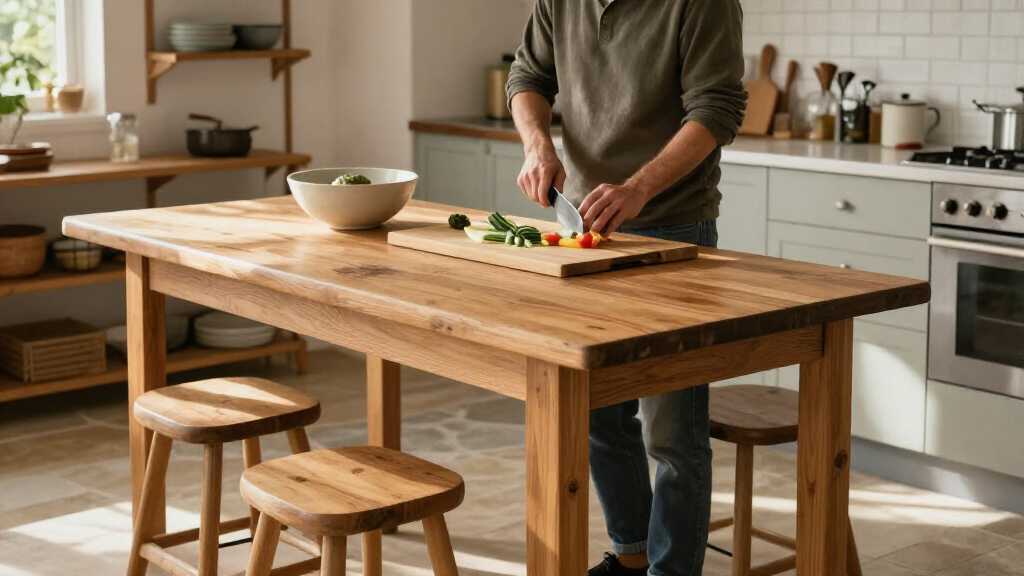
A cook’s table is a freestanding table used for tasks such as food preparation, casual meals and gathering. Unlike a built-in island, it does not have a bulky cabinet base attached to the floor, and some versions can be moved around the kitchen. Designers say that lighter appearance can be helpful in a compact room where a permanent island might take up too much space or make the layout feel crowded.
Its appeal is also visual. Many examples are made of wood and feature details such as turned legs, curved shapes and signs of age. Vintage and antique pieces can bring patina into a kitchen, while newer custom tables can provide a similar furniture-like effect. The idea is to make the central work surface feel like a piece of furniture rather than another run of cabinetry.
Designers describe the table as serving several roles: a place to prepare food, a spot for coffee or homework, and a focal point for informal entertaining. Designer Cynthia Lananh says a kitchen island that looks like furniture can feel more casual and approachable. She also recommends casters when a table needs to move between prep and dining use. Casters are one option, not a requirement; the right choice depends on the room and the table’s intended use.
A flexible kitchen center with a furniture feel
Designers are highlighting cook’s tables as an alternative to built-in islands. The appeal is flexibility and character, though the source offers no market data to measure how widely the trend has spread.
How the options differ
Each choice supports a different balance of openness, storage and adaptability.
- Freestanding and furniture-like
- Some versions can move
- Offers a surface for prep and gathering
- Fixed cabinetry
- Can include integrated storage and appliances
- May dominate a compact room
A table with several roles
The central surface can adapt to household routines and informal hosting.
Food prep
Choose a height and construction suited to kitchen tasks.
Coffee or homework
A shared surface can serve more than one purpose.
Casual entertaining
A furniture-like centerpiece can make the kitchen feel more approachable.
Fit it to the room
Designers suggest checking circulation, placement and intended use before choosing a table.
Consider available floor space and movement around the table.
Decide whether it will serve prep, dining, entertaining or several uses.
Compare height, shape, material and whether mobility is useful.
What the trend claim means
The article reports designers’ observations about a design direction.
| Evidence in the source | What it tells readers |
|---|---|
| Designers’ observations | Cook’s tables are drawing attention as an island alternative. |
| No sales or survey figures | The wider reach of the trend is unmeasured. |
| No price comparison | Costs and trade-offs depend on the specific kitchen and table. |
A More Flexible Kitchen Center
The appeal is partly practical: a freestanding table gives homeowners a central surface without committing to fixed cabinetry. That can matter in small or galley-style kitchens, where circulation space is limited, and in homes where the central area needs to serve more than one purpose. A movable table may also be easier to adapt as household routines change, although its usefulness depends on its size, weight and the available floor space.
The shift also reflects a design preference described by the sources: kitchens need not be arranged around a large, highly integrated island. A cook’s table can keep the room’s center open and create a more informal place to meet. Designer Becky Ducsik of The Phinery links this emphasis on gathering to changes in how people use their homes after the pandemic. That is her explanation of the design direction, not evidence that all homeowners share the preference.
For readers weighing a renovation or furnishing choice, the distinction has consequences for cost, storage and layout, but the source does not compare prices or quantify those trade-offs. A table may be less built-in and more adaptable, while an island can offer integrated storage and appliances. The right fit depends on which functions matter most in a particular kitchen.
Products Worth Considering

Google Nest Thermostat – Smart Programmable Wi-Fi Thermostat (Snow)

Dyson Cyclone V10 Origin Cordless Vacuum

Shark Pet Cordless Stick Vacuum, 40-Minute Runtime, Lightweight, IX141
As an affiliate, we earn on qualifying purchases.
From Fixed Islands to Furniture
The article describes a movement away from kitchens dominated by oversized islands and toward pieces that add warmth and character. It presents cook’s tables as one example of that preference, particularly where owners want a less sleek or minimal look. This is a design observation from the cited designers, not a dated industry-wide announcement or a documented sales trend.
Designer Amy Sklar says a traditional island can dominate a kitchen, while Ducsik suggests a cook’s table can anchor a larger room when storage and appliances are placed around the perimeter. Ducsik recommends keeping four to five feet of clearance around a table to support comfortable movement. For kitchens without room for a freestanding table in the center, she suggests using one as a peninsula extension at the end of cabinetry.
The form is not limited to small kitchens. In a larger room, a custom or vintage table may act as a centerpiece; in a tighter layout, the same furniture-like quality may help the space feel less crowded. The source also points to practical choices that shape the result: table height, material, outline and whether it needs to move.
“A traditional island can dominate a kitchen.”
— Amy Sklar, designer
The Trend’s Reach Is Unmeasured
The source does not provide sales figures, survey results or a defined time period to establish how many homeowners are choosing cook’s tables or whether interest is increasing across the wider market. The claim that they are gaining attention comes from a design article and the experiences of its cited designers; it should not be read as a quantified industry trend.
There is also no single specification for a cook’s table. Dimensions, height, construction and mobility vary, and the source gives no price comparison with built-in islands. A vintage table may sit lower than a standard counter, according to Sklar, and could need casters or leg extensions for food preparation. Whether a particular table is stable and suitable for that use depends on its construction and condition.
The suggested clearance of four to five feet is Ducsik’s design guidance in the article, not a universal building standard. The source does not address local requirements or provide measurements for specific kitchen plans. Homeowners would need to assess their own layout, circulation and intended use before selecting a table.
Measure Before Choosing a Table
The next step for anyone considering the approach is to measure the kitchen and determine how the table will be used: primarily for preparation, dining, entertaining or several of those functions. Designers cited in the source advise matching the table’s scale to the room and leaving enough space to move around it. In a tight layout, a peninsula-style placement may offer a gathering surface without putting a table in the center.
Buyers can then compare height, shape and material. Oak, maple and walnut are among the durable woods Lananh names; reclaimed wood can add a more rustic look, while metal or butcher-block tops offer different finishes and uses. Rounded corners may create a softer feel, while a rectangular table can provide more surface area and seating. The source recommends repeating wood tones in details such as shelving or serving pieces for a coordinated appearance.
For an older table, check whether its height and condition suit the planned tasks before adapting it. Casters or leg extenders may help with height or movement, but the article gives no installation guidance. The development reported here is a design preference rather than a scheduled product or policy change, so what happens next is likely to depend on individual renovation and furnishing decisions; no industry milestone or further announcement is specified.
Key Questions
What is a cook’s table?
A cook’s table is a freestanding table used in a kitchen for food preparation and, depending on its size and placement, gathering or dining. Unlike a built-in island, it is not fixed to the floor as cabinetry.
Why might a cook’s table work better than an island?
Designers say its lighter footprint and movable format can suit smaller kitchens or rooms that need a more flexible center. An island may still be preferable for homeowners who want integrated storage or appliances; the source does not compare costs or performance.
How much space should be left around one?
Designer Becky Ducsik recommends four to five feet of clearance around the table for comfortable movement. That is her design recommendation, not a universal code requirement, and the usable space in a particular kitchen will depend on its layout.
What should buyers check before choosing a vintage table?
Check the table’s dimensions, height, material and condition, then consider how it will be used. Some vintage tables sit lower than counter height, according to designer Amy Sklar; casters or leg extensions may be options, but suitability depends on the individual piece.
Source: housebeautiful.com