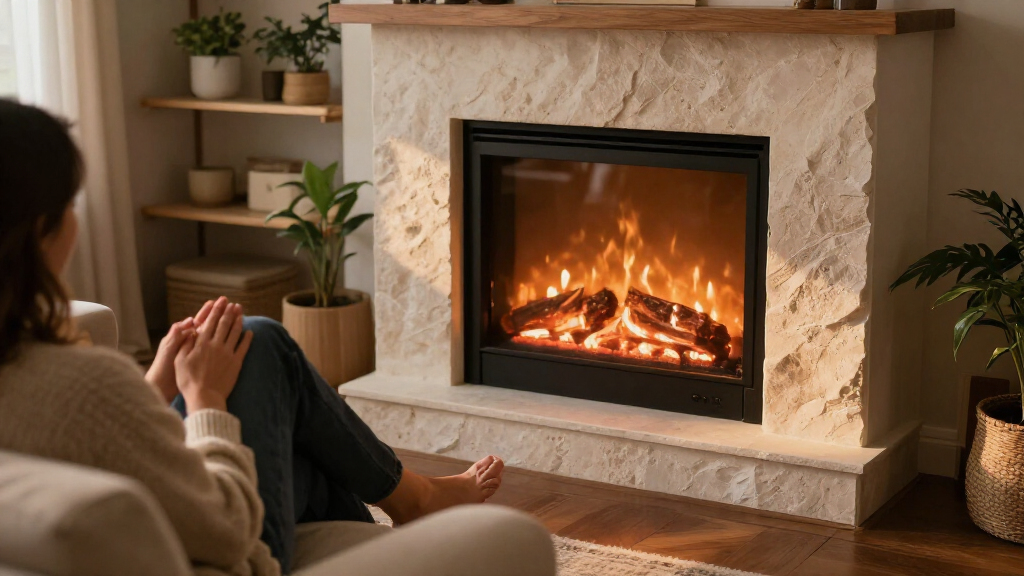
Choosing an electric fireplace for a living room comes down to how you want its heat to feel and how much you want to spend. Infrared models direct warmth toward people and furnishings, which can feel comfortable before the entire room warms. Fan-forced models heat air and push it outward, often at a lower purchase price. Both can add flame effects without heat, and both need a suitable electrical outlet, but neither makes the same kind of comfort tradeoff. Infrared is the stronger fit for a larger seating area or anyone who dislikes a steady blower; fan-forced is the sensible value pick for a smaller room or occasional supplemental heat.

Get furniture and decor delivered free with Prime
- Fast, free delivery on millions of items
- Prime Video, Amazon Music and more included
- Member-only deals all year

duraflame Freestanding Electric Fireplace Stove Heater with 3D Flame Effect
- ✔ Type: Freestanding electric stove heater
- ✔ Heating coverage: Up to 1,000 sq. ft. (stated)
- ✔ Heat output: 5,200 BTU

Silonn Electric Fireplace Heater, 24-Inch Corner Fireplace
- ✔ Type: Freestanding corner electric fireplace
- ✔ Maximum compatible size: 24 inches
- ✔ Heat output: 5,300 BTU

Touchstone Electric Fireplace — The Sideline 50-Inch In-Wall Recessed
- ✔ Type: 50-inch recessed electric fireplace
- ✔ Installation: Wall mount or in-wall recessed
- ✔ Heating coverage: 400 sq. ft. (stated)
At a Glance
| Criteria | Infrared electric fireplaces | Fan-forced electric fireplaces | Winner |
|---|---|---|---|
| Heating feel and coverage | Direct warmth reaches people and nearby surfaces; less dependent on heating all room air. | Warms room air and distributes it through the room with a fan. | A |
| Warm-up experience | Can feel warm quickly when seated in the heat’s path; room temperature may rise more gradually. | Blower spreads heated air, which may make the room feel more evenly warm after operation. | Depends |
| Noise | Typically quiet, though the appliance may still make operating sounds. | Fan noise is part of normal heating and may be noticeable in a quiet living room. | A |
| Purchase value | Often costs more; the premium buys a different heat delivery style, not necessarily more total output. | Often the lower-cost route to supplemental heat and flame effects. | B |
| Room-size fit | Useful for seating zones and open living areas where direct warmth is welcome. | A practical fit for compact or enclosed living rooms; performance depends on room layout and insulation. | Depends |
| Flame-only use | Usually supports flame effects with heat off; verify controls and modes for the chosen model. | Usually supports flame effects with heat off; verify controls and modes for the chosen model. | Tie |
| Installation and upkeep | Commonly plug-in; keep clearances and outlet requirements in mind, and clean air inlets as directed. | Commonly plug-in; keep clearances and outlet requirements in mind, and clean air inlets as directed. | Tie |
duraflame Freestanding Electric Fireplace Stove Heater with 3D Flame Effect
For a living room that needs an atmospheric centerpiece without a construction project, the duraflame freestanding stove is the most adaptable pick in this group. Its side viewing windows, opening glass door, brick-style back panel, and glowing logs give it a traditional stove appearance. That shape reads differently from the sleek, wall-spanning Touchstone and the compact, modern Silonn: it is better suited to a room where a standalone accent feels at home than to a space designed around a built-in screen.Its strongest practical advantage is flexibility. The listing describes it as portable and gives it independent flame and heat controls, so we can keep the visual glow on when we do not want supplemental warmth. The stated infrared coverage reaches up to 1,000 square feet, broader than the Touchstone’s listed 400 square feet; however, the figures are manufacturer claims, and room layout or insulation can affect real comfort. At 1,500 watts, it is still best understood as a zone heater for occupied space, not a replacement for a home’s main heating system.There are meaningful compromises. It occupies floor space, and its traditional form may clash with a minimalist living room where a recessed unit would look more deliberate. It also lacks the app control offered by Silonn. Buyers seeking a broad, flush-mounted visual anchor should look instead at Touchstone; those who want a movable, classic-looking unit with a flame-only setting get the clearest match here.
Pros:
- Freestanding design can be moved between rooms.
- Flame and heat can operate independently for year-round ambiance.
- Stated infrared heating coverage up to 1,000 square feet.
- Adjustable thermostat and flame brightness settings.
Cons:
- Uses floor space and may not suit contemporary built-in layouts.
- No app control is listed, unlike the Silonn.
- The 1,500-watt draw makes it a supplemental heater rather than a whole-home solution.
Best for: Living rooms that need a portable, traditional-looking accent with separate flame and heat operation.
Not ideal for: Minimalist rooms planned around a built-in fireplace, or buyers who need app-based controls.
Bottom line: We rank it first for the living room because it combines flexible placement, a convincing traditional form, and independent flame control with the broadest stated coverage in this lineup.
“We rank it first for the living room because it combines flexible placement, a convincing traditional form, and independent flame control with the broadest stated coverage in this lineup.”
Silonn Electric Fireplace Heater, 24-Inch Corner Fireplace
The Silonn 24-inch corner fireplace is the most control-rich option for buyers who want a compact accent that can sit in a room corner. Its square form is a different proposition from the duraflame’s freestanding stove silhouette: it makes more sense when the main furniture arrangement already leaves an unused angle, rather than when you want a traditional hearth to anchor a wall. Compared with Touchstone, it avoids committing to a recessed opening and can be repositioned as the room changes.Silonn’s clearest differentiator is its app and remote control. The listing says buyers can adjust settings remotely, and it includes five flame brightness levels, temperature control from 62°F to 82°F, and a timer adjustable from one to eight hours. Those choices can make it easier to tailor the effect for a quiet evening or set a defined operating window. The stated 37 dB noise level is also useful context for a living room where conversation or television matters, although actual perception depends on the room and operating mode.The biggest unknown is coverage: unlike duraflame and Touchstone, the supplied product information does not state a heating-area figure. Its 1,400-watt power and 5,300 BTU output offer a basis for comparison, but not enough to conclude it will comfortably heat a particular living room. Safety features include overheat protection, a child lock, and automatic shutdown if tilted more than 45 degrees. Choose it for corner placement and flexible controls; skip it if a published coverage figure or a broad wall-mounted focal point is central to your decision.
Pros:
- Corner-oriented 24-inch format can use an otherwise underused space.
- App and remote control offer more operating flexibility than the duraflame.
- Five brightness levels and adjustable temperature from 62°F to 82°F.
- Includes a timer, child lock, overheat protection, and tilt shutdown.
Cons:
- The supplied details do not specify heating coverage.
- Its modern corner form may not fit a traditional living-room scheme.
- The stated 37 dB noise level is not silent and may be noticeable in especially quiet rooms.
Best for: Buyers with an open living-room corner who want app and remote control, adjustable flame brightness, and a timer.
Not ideal for: Anyone who needs a stated heating-coverage figure or wants a wide, recessed fireplace to define a feature wall.
Bottom line: We recommend Silonn when corner placement and connected controls matter more than a documented coverage area or a built-in appearance.
“We recommend Silonn when corner placement and connected controls matter more than a documented coverage area or a built-in appearance.”
Touchstone Electric Fireplace — The Sideline 50-Inch In-Wall Recessed
When a living-room plan already includes a feature wall, the Touchstone Sideline 50-inch offers the most integrated look in this comparison. Its recessed, wall-mounted format gives it a broad rectangular presence that can read as part of the room architecture. That makes it a stronger visual match than the duraflame stove for contemporary interiors, but it also changes the buying decision: this is not a unit we choose for easy relocation. Touchstone specifically advises measuring the opening’s height, width, and depth before ordering.The listing describes 30 flame and ember color combinations, log and crystal hearth options, a thermostat, and a 1,500-watt heater. With stated coverage of 400 square feet, it has a smaller published area than duraflame’s 1,000-square-foot claim. That difference makes the Touchstone easier to position as a room accent with supplemental heat rather than the broadest-coverage option here. Its 5,000 BTU output sits close to the others’ stated figures, but output alone does not establish how evenly a particular living room will feel warm.Installation is the deciding tradeoff. The unit offers a three-prong outlet and a hardwired option, giving some flexibility for a planned setup, yet wall preparation and a correctly sized opening add effort and reduce portability. Silonn is easier to place without committing to a wall, while duraflame is the better choice for a classic freestanding look. We would pick Touchstone when the finished wall appearance is the priority and the room can accommodate its fit and installation requirements.
Pros:
- Wide 50-inch format creates a strong wall-centered visual feature.
- Thirty flame and ember color combinations allow varied ambiance.
- Includes both log and crystal hearth options.
- Offers a three-prong outlet and a hardwired installation option.
Cons:
- Requires careful opening measurements and a planned installation.
- Stated heating coverage is 400 square feet, below duraflame’s listed figure.
- Less suitable for renters or anyone who wants to move the fireplace between rooms.
Best for: Homeowners planning a contemporary feature wall who can measure and prepare a suitable recessed or wall-mounted space.
Not ideal for: Renters, frequent room rearrangers, and buyers who prioritize portability or the broadest stated heating coverage.
Bottom line: We place Touchstone third overall but first for an installation-led feature wall, where its wide format and flame choices justify giving up portability.
“We place Touchstone third overall but first for an installation-led feature wall, where its wide format and flame choices justify giving up portability.”
As an Amazon Associate we earn from qualifying purchases.
Key Differences
The main difference is where the heat goes. Infrared models send warmth toward people and objects in their path, so a seated person can feel comfortable without waiting for all the room air to warm. Fan-forced units warm air and circulate it. That can suit a compact living room where occupants want more of the space to feel warm, though the fan adds sound and the result depends on how freely air moves around the room.
Price and comfort pull in opposite directions. Fan-forced fireplaces are often cheaper and make a straightforward choice for occasional supplemental heat. Infrared can justify a higher price when direct warmth, quiet operation, or a broad seating area matters day to day. Neither category guarantees a lower energy bill or can replace a home’s primary heating system; output, room conditions, thermostat behavior, and usage all matter.
For a living room bought partly for atmosphere, flame-only operation may matter as much as heating style. Both types commonly offer it, but features vary by model. Check the controls, flame settings, heat output, sound, dimensions, and electrical requirements before comparing prices. The best fit is the unit whose heating pattern works with the room’s seating and layout.
Detailed Comparison
Heating feel and coverage (Infrared electric fireplaces wins — moderate)
Infrared wins for direct comfort: it can warm people and nearby furnishings without first heating all the air. Fan-forced models spread warmth through the air, which may suit occupants who want a more general room effect. This is a moderate difference because layout matters: direct heat helps when seating is in range, while circulating air can be useful in a compact enclosed space.
Warm-up experience (moderate difference)
There is no universal winner. Infrared can feel warm quickly to someone in its path, while fan-forced heat moves into the room as the blower circulates warm air. A room’s size, insulation, and furniture placement change the result. The difference is moderate for a living room used in short sessions; assess where people sit and how quickly the space needs to feel comfortable.
Noise (Infrared electric fireplaces wins — moderate)
Infrared usually wins because it does not need a blower to distribute heat. Fan-forced models produce fan noise during heating, which may be easy to ignore during conversation but more noticeable during quiet reading or television. The gap is minor to moderate depending on personal sensitivity and the specific model; check noise information or listen to the unit in person if possible.
Purchase value (Fan-forced electric fireplaces wins — moderate)
Fan-forced units usually win on upfront value, offering supplemental heat and a flame effect at a lower price. Infrared costs more in many product lines, so its added expense makes sense when direct warmth or quieter heat will be used often. The gap is moderate, but compare actual features and output rather than assuming a higher price means stronger heating.
Room-size fit (moderate difference)
This depends on the room. Infrared can suit a broad living room seating zone if the fireplace can be positioned to reach the occupants. A fan-forced unit may be more practical in a smaller, enclosed room where air circulation can affect the whole space. Neither type’s label alone proves it can heat a particular room; match the manufacturer’s stated coverage and output to the space.
Flame-only use (minor difference)
Neither category has a built-in advantage here. Many electric fireplaces let users run the flame display without heat, so either can provide ambience outside the heating season. Controls and visual settings vary by model. Treat flame-only operation as a product feature to confirm rather than a reason to choose infrared or fan-forced heating.
Installation and upkeep (minor difference)
This is generally a tie. Both types are commonly available as plug-in appliances, though installation, clearance, and outlet requirements depend on the model. Fan models have air inlets that need to stay clear and may need routine cleaning as described by the manufacturer; infrared appliances also require the specified clearances and care. Check the manual before placing either near furniture or curtains.
Infrared electric fireplaces: Pros and Cons
Pros:
- Direct warmth can feel comfortable at the seating area without waiting for all the room air to warm.
- Typically avoids the steady blower sound of fan-forced heating.
- Can suit larger or open seating areas when positioned for direct warmth.
Cons:
- Often carries a higher upfront price.
- People or furnishings outside the heat’s path may feel less benefit.
- Room coverage still depends on the unit’s output and placement.
Fan-forced electric fireplaces: Pros and Cons
Pros:
- Often costs less for a flame display and supplemental heating.
- Circulates warm air, which can suit a smaller enclosed living room.
- Offers a straightforward option for occasional heating.
Cons:
- Fan noise may be noticeable during quiet use.
- Air circulation and room layout affect how evenly warmth is felt.
- May feel less comfortable to someone seated outside the warm airflow.
Who Should Choose What
Choose Infrared electric fireplaces if:
- You want direct warmth at a sofa or seating zone, especially in a larger living room.
- Fan noise would distract you during reading, conversation, or television.
- You will use the heater often enough to value its heating feel over a lower purchase price.
Choose Fan-forced electric fireplaces if:
- You want a lower-cost fireplace for occasional supplemental heat.
- Your living room is compact and enclosed, with a layout that allows warm air to circulate.
- You are comfortable with fan sound and prefer air-based heating across the room.
Skip both if: Skip both as a primary heating solution if the living room needs dependable whole-home heating; compare properly sized permanent heating options instead.
Value for Money
Fan-forced is usually the better value when price leads the decision and the fireplace will provide occasional supplemental warmth. Its lower upfront cost leaves less to recoup through use, and it can deliver the flame effect many buyers want. Infrared earns its premium for people who use the heater regularly, sit within its direct warming area, or find blower noise irritating. Paying more makes sense for that comfort difference; it does not automatically buy greater room coverage or lower running costs. Compare the exact model’s output, controls, warranty, and energy use at the settings you expect to use.
Final Verdict
For most buyers who want the lowest-cost route to a living-room flame effect with supplemental heat, choose a fan-forced electric fireplace. It is the practical value pick for occasional use in a smaller enclosed room. Choose infrared if the fireplace will be used often and direct, quieter warmth at the seating area matters enough to justify paying more. The deciding factor is the comfort pattern: warm people and nearby surfaces with infrared, or circulate warm air with a fan. Check model-specific output and room coverage before buying either.
Frequently Asked Questions
Which electric fireplace is better for a living room, infrared or fan-forced?
Infrared is the better fit when you want direct warmth at the seating area and prefer quieter operation. Fan-forced is a better value for occasional heat in a compact, enclosed room. Room layout and the model’s rated output can change the choice.
Does an infrared electric fireplace heat a whole room?
It can contribute heat, but its direct warmth is strongest for people and objects in its path. Check the manufacturer’s coverage guidance and consider the room layout; do not assume the infrared label guarantees whole-room comfort.
Are fan-forced electric fireplaces noisy?
They make fan sound while heating. How noticeable it is depends on the model and the room, and it may stand out more during quiet activities. Check product specifications or listen to a sample unit when possible.
Is infrared worth paying more for?
It can be worth the premium if you use the heater frequently and value direct warmth or less blower noise. For occasional supplemental heat and ambience, a less expensive fan-forced model is usually the stronger value.
Can I use either type without heat?
Many electric fireplaces offer flame-only operation, but features vary. Confirm that the model lets you turn heat off independently if you want ambience during warmer months.