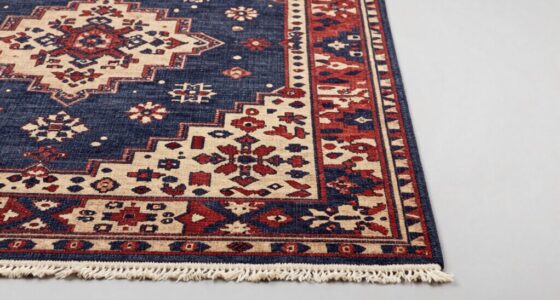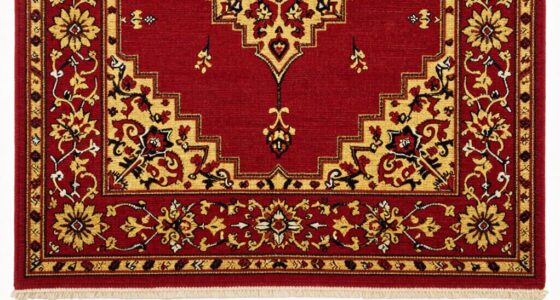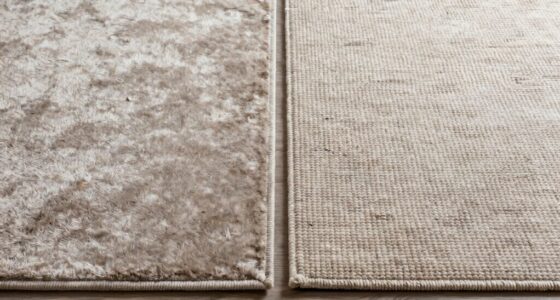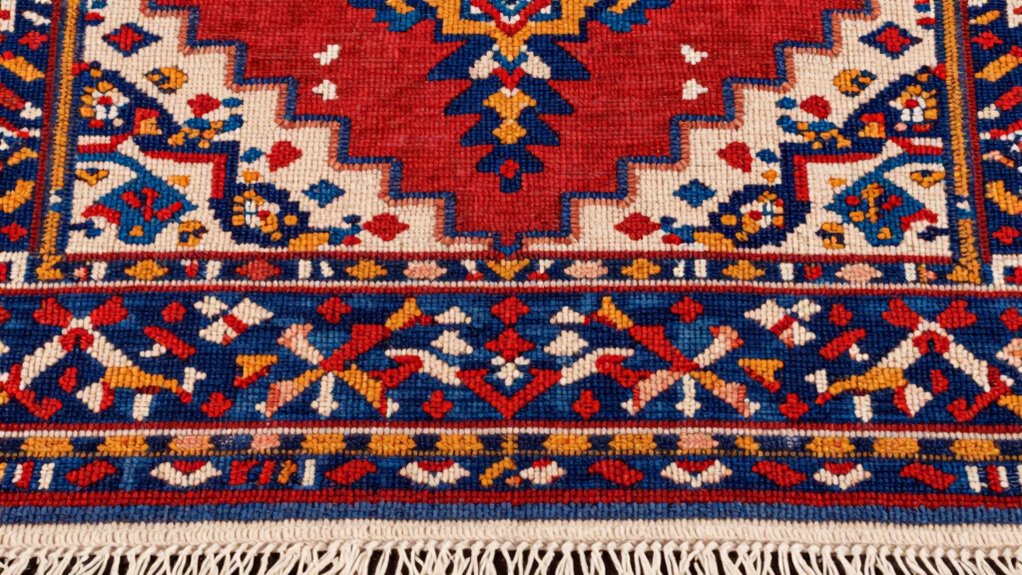

To understand a rug’s construction from the back, look for the knot density, which shows how tightly packed the knots are—more knots usually mean better quality. Check the weaving technique: hand-knotted rugs have knots tied around warp threads and have a textured surface, while flatweaves show a woven pattern. Examine the edges for secure binding, and note any visible dye variations. Keep exploring to uncover more details that define craftsmanship and durability.

Get furniture and decor delivered free — and shop member deals
- Fast, free delivery on millions of items
- Access to Prime Big Deal Days deals on October 6–7
- Prime Video, Amazon Music and more included
Key Takeaways
- Examine the back for visible knots; hand-knotted rugs show individual knots tied around warp threads.
- Check for uniformity; machine-made rugs have consistent, evenly spaced backing patterns.
- Observe weave patterns; flatweaves display geometric designs directly on the back without knots.
- Look for dye indicators; variations or distinct patterns in backing can reveal natural versus synthetic dyes.
- Assess edge binding; secure, well-finished edges suggest higher construction quality and durability.
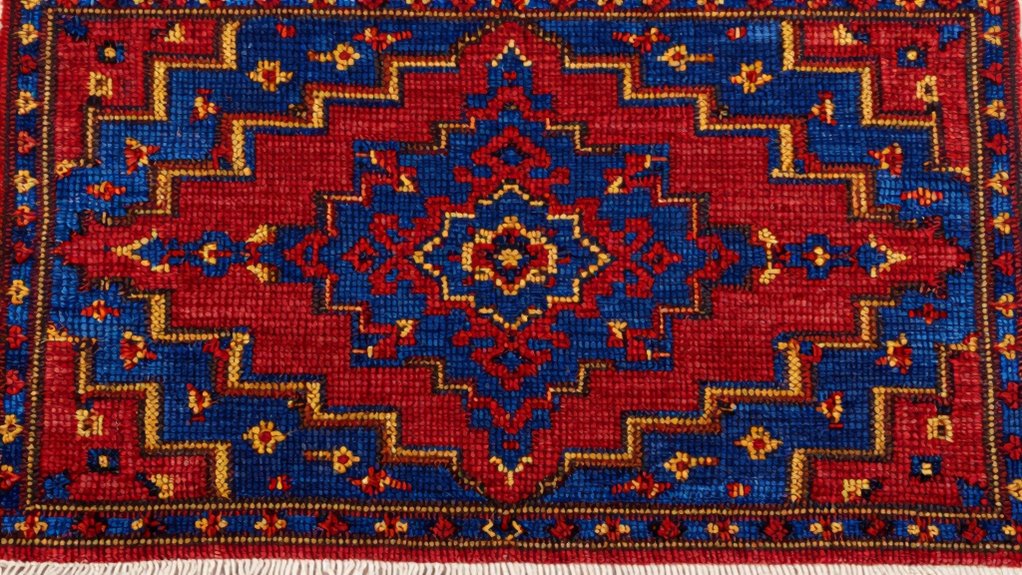
Understanding how a rug is constructed can greatly influence your buying decision and guarantee you choose a piece that fits your needs. When you look at the back of a rug, you’re getting a clear view of its underlying craftsmanship. The way the rug is woven reveals details about its quality, durability, and the techniques used to create it. One of the most important aspects to examine is the knots per inch, which directly correlates with the rug’s density and overall quality. Generally, the higher the number of knots per inch, the finer and more durable the rug tends to be. If you see very tight, closely packed knots, it indicates skilled craftsmanship and a longer-lasting piece, especially important if you plan to use the rug daily.
Higher knots per inch mean better quality, durability, and craftsmanship in a rug.
As you examine the back, pay close attention to the weaving techniques. Different styles, such as knotting or flatweaves, leave distinct marks on the underside. For instance, hand-knotted rugs will show individual knots tied around the warp threads, creating a textured surface that’s often uneven but detailed. You might notice small, irregular bumps or loops—these are signs of meticulous, manual work. On the other hand, machine-made rugs often have a more uniform appearance with a stable, consistent backing. Recognizing these differences helps you understand whether a rug is handcrafted or produced by machine, which informs its value and longevity. Understanding the weaving techniques can help you assess the craftsmanship more accurately.
The weave pattern on the back also tells you about the rug’s construction. In hand-knotted rugs, the knots are tied onto the warp threads, and you can often see them distinctly. If you run your fingers across the back, you’ll notice the pile—if any—rising from the knots, which hints at the rug’s thickness and softness. Flatweave rugs, like kilims or dhurries, don’t have knots; instead, they’re woven with a tapestry technique that results in a flat, smooth surface. The back of these rugs typically displays a clear, geometric pattern that mirrors the front, and you’ll see the weft and warp threads crossing in a tight, consistent pattern. Additionally, the dyeing process used in the fibers can sometimes be visible from the back, indicating whether natural or synthetic dyes were employed. Knowing how to read these construction details from the back gives you a better sense of a rug’s quality and craftsmanship. It helps you distinguish between a well-made piece and one that might fall apart quickly.
A closer look at the backing can also reveal the finish quality, such as how securely the edges are bound, which impacts the rug’s longevity. By paying attention to knots per inch, weaving techniques, and the overall backing pattern, you gain insight into how the rug was made, how long it will last, and whether it matches your needs. This knowledge empowers you to make a confident, informed purchase that you’ll enjoy for years to come.
hand knotted rug with high knot density
As an affiliate, we earn on qualifying purchases.
As an affiliate, we earn on qualifying purchases.
Frequently Asked Questions
What Tools Are Needed to Examine Rug Backing?
You’ll need a good magnifying glass or a flashlight to examine the rug backing closely. Use your tools to inspect the rug padding and fringe thoroughly, checking for signs of wear or damage. A pair of tweezers can help you lift and view the backing details better. These tools make it easier to assess the rug’s quality, ensuring you spot any issues with the backing, padding, or fringe before making a purchase or cleaning.
How Can I Identify a Handmade Versus Machine-Made Rug?
Did you know over 90% of handmade rugs show slight variations? To identify if a rug is handmade or machine-made, check pattern consistency and thread density. Handmade rugs often have subtle irregularities and varied thread density, reflecting craftsmanship. Machine-made rugs tend to have perfectly uniform patterns and consistent thread density. So, examine the back for uneven knots and slight imperfections, which indicate a handmade piece, versus the precise, uniform finish of machine-made rugs.
Does Rug Age Affect Its Construction Details?
Rug aging does affect its construction details, as over time, natural wear and environmental factors cause subtle changes. You might notice thinner areas, frayed fibers, or uneven pile height, which reflect construction changes due to aging. These signs help you understand a rug’s history and authenticity. Keep in mind, older rugs often show craftsmanship that’s been enhanced or softened through age, adding character and value to their construction.
Can the Back Reveal Dye Quality?
Yes, the back of a rug can reveal dye quality through its dye consistency. If the dye is uneven or shows blotches, it indicates lower quality dye or inconsistent application. Additionally, examining the backing material helps; high-quality dyes usually result in more uniform coloration. A well-constructed rug with proper backing supports even dye absorption, ensuring vibrant, lasting colors. So, inspecting these aspects on the back gives you clues about the dye quality.
How Do Different Knot Types Influence Durability?
You might think all knots are equal, but different knot types truly influence durability. For example, Persian knots, with their higher knot density, create a sturdier rug, thanks to increased material strength. Meanwhile, asymmetrical knots might look charming but can wear out faster. So, if you want longevity, opt for dense, tightly tied knots — it’s ironic how a simple knot type can determine your rug’s lifespan.
Conclusion
By understanding how to read a rug’s construction from the back, you can better assess its quality and durability. Remember, a tightly woven rug with even knots typically lasts longer and ages more gracefully. Did you know that hand-knotted rugs can take hundreds of hours to complete? So, next time you’re shopping, look beyond the surface—your knowledge will help you make smarter choices and find a rug that truly stands the test of time.
Fall Picks
fall essentials
As an affiliate, we earn on qualifying purchases.