A premium under-sink water filter can improve water at one dedicated faucet, but it does not filter every tap in the house; for that, you need a point-of-entry system. My best overall pick here is the APEC WFS-1000, a practical three-stage option for households seeking straightforward drinking-water filtration. The iSpring RCC7-BN stands out for buyers who want reverse osmosis, while the Pentair Everpure H-300-NXT is a compelling choice for a more specialized premium system. The main tradeoffs are filtration scope, water waste and flow, installation demands, and ongoing filter upkeep. Read on for the full breakdown and help matching a system to your water and kitchen.

Get furniture and decor delivered free with Prime
- Fast, free delivery on millions of items
- Prime Video, Amazon Music and more included
- Member-only deals all year
Complete the kit


Key Takeaways
- These are point-of-use systems, not whole-house filters. Each is installed under a sink and treats water delivered through its connected faucet or line, not every household outlet.
- Reverse osmosis is the specialist choice, not the default upgrade. The iSpring RCC7-BN offers a different filtration approach from the six non-RO options, with added plumbing and reject-water considerations.
- Three-stage systems are the clearest middle ground. The APEC WFS-1000 and iSpring US31-NC combine multi-stage treatment with a more conventional under-sink setup.
- Flow and faucet compatibility can matter as much as filtration. The Pentair Everpure EF-1500 is a full-flow system, while other designs may use a dedicated faucet or have distinct installation needs.
- Maintenance and certification details deserve a final check. Filter replacement schedules, compatible cartridges, and claims verified for the exact model should shape the decision alongside the system name.
| APEC Water Systems WFS-1000 3-Stage Under-Sink Water Filter System |  | Best for Straightforward, Supported Filtration | Model: WFS-1000 | Filtration stages: 3 | Installation: Under sink | VIEW ON AMAZON | See Our Full Breakdown |
| iSpring US31-NC 3-Stage Under-Sink Water Filter System with Faucet |  | Best for High-Capacity Chloramine Reduction | Model: US31-NC | Filtration method: Sedimentation and carbon block | Filter life: Up to 12 months | VIEW ON AMAZON | See Our Full Breakdown |
| Pentair Everpure EF-1500 Full-Flow Drinking Water System |  | Best for Filtering Existing Taps | Model: EF-1500 (EV985800) | Filtration: 0.5 micron | Capacity: 1,500 gallons | VIEW ON AMAZON | See Our Full Breakdown |
| iSpring RCC7-BN 5-Stage Under-Sink Reverse Osmosis Water Filter System |  | Best for Broad Reverse-Osmosis Treatment | Model: RCC7-BN | Filtration stages: 5 | Purification method: Reverse osmosis, activated carbon, and carbon block | VIEW ON AMAZON | See Our Full Breakdown |
| Pentair Everpure H-300-NXT Drinking Water System |  | Best for a Dedicated Premium Filter with Mineral Retention | Model: H-300-NXT (EV927151) | Filtration method: Micro-Pure precoat filtration and pleated membrane; carbon block | Capacity: 300 gallons | VIEW ON AMAZON | See Our Full Breakdown |
| Waterdrop TST-UF 0.01 μm Ultra-Filtration Under-Sink Water Filter System | 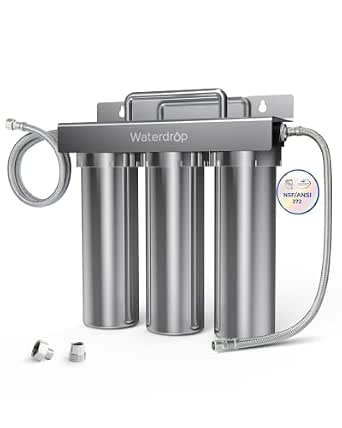 | Best for Fine-Particle Filtration | Filtration accuracy: 0.01 μm | Stages: 3 | Purification method: Ultra filtration | VIEW ON AMAZON | See Our Full Breakdown |
| ICEPURE WFS6310A Under-Sink Water Filter System |  | Best for High Capacity and Simple Installation | Model: WFS6310A-10 | Purification method: Activated carbon | Filter precision: 0.5 μm | VIEW ON AMAZON | See Our Full Breakdown |
| whole house under sink water filter premium | Model | Capacity | Maximum flow rate |
|---|---|---|---|
| APEC Water Systems WFS-1000 3- | WFS-1000 | — | — |
| iSpring US31-NC 3-Stage Under- | US31-NC | Up to 10,000 gallons | 1 GPM |
| Pentair Everpure EF-1500 Full- | EF-1500 (EV985800) | 1,500 gallons | 2.2 GPM |
| iSpring RCC7-BN 5-Stage Under- | RCC7-BN | 75 gallons | 3.4 liters per minute |
| Pentair Everpure H-300-NXT Dri | H-300-NXT (EV927151) | 300 gallons | 1.5 GPM |
| Waterdrop TST-UF 0.01 μm Ultra | — | 8,000 gallons | 2.5 GPM listed; description states up to 1.59 GPM |
| ICEPURE WFS6310A Under-Sink Wa | WFS6310A-10 | Up to 12,000 gallons per cartridge | 1.75 GPM |
More Details on Our Top Picks
APEC Water Systems WFS-1000 3-Stage Under-Sink Water Filter System
The APEC WFS-1000 is a sensible choice for buyers who want a three-stage system aimed at reducing chemicals, unpleasant taste, and odors without stepping up to reverse osmosis. It works with tap or well water and comes with a lead-free chrome faucet and NSF-certified food-grade tubing, giving the installation package more completeness than a filter-only setup. Compared with the iSpring RCC7-BN, it is the simpler route: it does not offer the same specified five-stage RO treatment, but also avoids an RO system’s more involved configuration. Its long-lasting filters and lifetime WQA specialist support are useful for owners who want help beyond installation. The tradeoff is that the supplied faucet means filtered water comes from a separate tap, and under-sink installation is required.
Pros:- Designed to reduce chemicals, taste, and odors in tap or well water
- Includes a lead-free chrome faucet and NSF-certified food-grade tubing
- Long-lasting filters reduce how often routine replacements are needed
- Lifetime support from a WQA water specialist
Cons:- Requires under-sink installation and space for the filter assembly
- Uses a dedicated faucet rather than filtering water at existing taps
- The provided product details do not specify capacity or flow rate
Best for: Homeowners with tap or well water who want a conventional three-stage filter, a dedicated faucet, and access to ongoing water-system support.
Not ideal for: Buyers seeking reverse-osmosis treatment or filtered water from their existing regular taps; the WFS-1000 is a separate-faucet under-sink system.
- Model:WFS-1000
- Filtration stages:3
- Installation:Under sink
- Water sources:Tap water and well water
- Faucet:Lead-free chrome
- Tubing:NSF-certified food-grade
- Guarantee:1-year satisfaction guarantee
- Support:Lifetime support from a WQA water specialist
Our verdict“Choose the APEC WFS-1000 if you want a supported, three-stage under-sink filter for tap or well water rather than a reverse-osmosis system.”
iSpring US31-NC 3-Stage Under-Sink Water Filter System with Faucet
The iSpring US31-NC stands out for combining sediment and carbon-block filtration with a stated capacity of up to 10,000 gallons or 12 months. Its focus on chloramine, chlorine, VOCs, and sediment suits households that want taste and contaminant reduction while retaining beneficial minerals. Unlike the Pentair Everpure EF-1500, which filters water at existing taps, this iSpring includes a dedicated faucet; the clear housing also makes the filter assembly easier to inspect. Its listed 1 GPM maximum flow rate is a practical limit for filling containers quickly, and it does not lower total dissolved solids. Buyers should also note that the description calls the unit three-stage while also referring to advanced five-stage filtration, so the stage count is not presented consistently.
Pros:- Targets chloramine, chlorine, sediment, VOCs, and other listed contaminants
- Stated capacity of up to 10,000 gallons or 12 months
- Retains beneficial minerals and does not use reverse osmosis
- Includes a top-mount faucet and clear filter housing
Cons:- Does not lower total dissolved solids
- Maximum listed flow rate is 1 GPM
- Product details conflict between a three-stage system and five-stage advanced filtration
Best for: Households focused on chloramine and chlorine reduction that want a long stated filter capacity, retained minerals, and a dedicated drinking-water faucet.
Not ideal for: Buyers who need lower total dissolved solids, faster-than-1-GPM dispensing, or a product description with an unambiguous filtration-stage count.
- Model:US31-NC
- Filtration method:Sedimentation and carbon block
- Filter life:Up to 12 months
- Capacity:Up to 10,000 gallons
- Maximum flow rate:1 GPM
- Dimensions:13 × 5.3 × 14.2 inches
- Installation:Under sink; top-mount faucet installation
- Certifications and testing:NSF/ANSI 58 certified cartridges; catalytic carbon media SGS-tested against NSF 42
Our verdict“Pick the US31-NC if chloramine reduction and a long stated service capacity matter more than TDS reduction or faster dispensing.”
Pentair Everpure EF-1500 Full-Flow Drinking Water System
The Pentair Everpure EF-1500 is the clearest fit for buyers who would rather avoid a separate drinking-water faucet: it filters water at regular taps and has a listed 2.2 GPM flow rate. Its 0.5-micron filtration and NSF/ANSI 42, 53, and 401 certifications align with stated reductions for chlorine taste and odor, lead, microplastics, and certain cysts, while retaining naturally occurring minerals. That makes it a different proposition from the APEC WFS-1000, which includes its own faucet and is also described for well water. The EF-1500’s main compromise is its 1,500-gallon cartridge capacity, which is lower than the iSpring US31-NC’s stated 10,000 gallons. The built-in shutoff helps make cartridge changes quicker and less messy, but the system still needs under-sink space.
Pros:- Filters water at regular taps without a separate faucet
- Listed 2.2 GPM flow rate supports faster dispensing than the US31-NC
- NSF/ANSI 42, 53, and 401 certifications and 0.5-micron filtration
- Built-in shutoff supports quicker, lower-mess cartridge changes
Cons:- Cartridge capacity is 1,500 gallons, well below the US31-NC’s stated 10,000 gallons
- Requires under-sink installation space
- Replacement cartridge is needed after the rated capacity
Best for: Homeowners who want filtered water from their existing taps, a higher listed flow rate, and certified reductions for the contaminants specified.
Not ideal for: Households seeking a dedicated filtered-water faucet, very high cartridge capacity, or a system specifically described for both tap and well water.
- Model:EF-1500 (EV985800)
- Filtration:0.5 micron
- Capacity:1,500 gallons
- Maximum flow rate:2.2 GPM
- Certifications:NSF/ANSI 42, 53, and 401
- Installation space:5 in W × 15 in H × 5 in D
- Operating pressure:10–125 psi
- Operating temperature:35–100°F
- Replacement cartridge:EV985850
Our verdict“Choose the EF-1500 if filtering at existing taps and a 2.2 GPM flow rate matter more than maximizing cartridge capacity.”
iSpring RCC7-BN 5-Stage Under-Sink Reverse Osmosis Water Filter System
For buyers seeking more extensive dissolved-contaminant reduction, the iSpring RCC7-BN is the lineup’s reverse-osmosis pick. Its five-stage process and NSF/ANSI 58 certification distinguish it from the carbon-based APEC WFS-1000 and Pentair systems, with stated reductions that include lead, chlorine, fluoride, and PFAS. It needs no power and includes a brushed-nickel faucet, so the installation adds a dedicated filtered-water tap without an electrical connection. That broader treatment comes with a larger under-sink footprint—about 23.62 × 15.75 × 11.81 inches—and the product data lists a 75-gallon capacity without specifying the time basis. Compared with the iSpring US31-NC, this is the better fit when RO treatment is the priority, but not for buyers who want minerals retained or a compact, simpler carbon filter.
Pros:- Five-stage reverse-osmosis filtration with NSF/ANSI 58 certification
- Stated reductions include lead, chlorine, fluoride, and PFAS
- Operates without a power source
- Includes a brushed-nickel faucet
Cons:- Larger under-sink footprint than the more compact carbon-filter systems
- Requires a dedicated faucet and under-sink installation
- Listed 75-gallon capacity has no stated time basis in the supplied product details
Best for: Households prioritizing NSF/ANSI 58-certified reverse osmosis and stated reduction of contaminants such as fluoride and PFAS, with room for a larger under-sink system.
Not ideal for: Buyers who want to retain naturally occurring minerals, avoid a dedicated faucet, or have limited cabinet space for a larger RO assembly.
- Model:RCC7-BN
- Filtration stages:5
- Purification method:Reverse osmosis, activated carbon, and carbon block
- Certification:NSF/ANSI 58
- Capacity:75 gallons
- Maximum flow rate:3.4 liters per minute
- Supported maximum TDS:750 ppm
- Dimensions:23.62 × 15.75 × 11.81 inches
- Faucet finish and power:Brushed nickel; no power needed
Our verdict“Choose the RCC7-BN if broad reverse-osmosis treatment is your priority and your cabinet can accommodate its larger system.”
Pentair Everpure H-300-NXT Drinking Water System
The Pentair Everpure H-300-NXT suits buyers who want a dedicated faucet and a broad set of stated contaminant reductions while keeping naturally occurring minerals. Its Micro-Pure precoat filtration and pleated membrane are described as reducing chlorine taste and odor, lead, microplastics, cysts, pharmaceuticals, and other contaminants; NSF/ANSI 42, 53, and 401 certifications add useful context. Compared with the Everpure EF-1500, it includes its own faucet rather than filtering at regular taps, and its stated 1.5 GPM flow rate is lower than the EF-1500’s 2.2 GPM. The tradeoff is capacity: at 300 gallons, its cartridge rating is much lower than either the EF-1500’s 1,500 gallons or the US31-NC’s 10,000 gallons. Its slim 5 × 5-inch footprint is helpful, though the 22-inch height needs checking.
Pros:- Stated reductions include lead, microplastics, pharmaceuticals, and cysts
- NSF/ANSI 42, 53, and 401 certifications
- Includes a dedicated faucet and installation hardware
- Slim 5 × 5-inch footprint and quick-change cartridge with built-in shutoff
Cons:- 300-gallon capacity is substantially lower than the EF-1500 and US31-NC
- Listed maximum flow rate is 1.5 GPM, below the EF-1500’s 2.2 GPM
- The 22-inch system height may not fit every under-sink cabinet
Best for: Buyers who want a dedicated faucet, stated reductions that include pharmaceuticals and microplastics, and mineral retention in a narrow under-sink installation.
Not ideal for: High-volume households that would rather maximize capacity or flow rate; its cartridge is rated for 300 gallons and its height is 22 inches.
- Model:H-300-NXT (EV927151)
- Filtration method:Micro-Pure precoat filtration and pleated membrane; carbon block
- Capacity:300 gallons
- Filter life:About 1 year
- Dimensions:5 × 5 × 22 inches
- Maximum flow rate:1.5 GPM
- Certifications:NSF/ANSI 42, 53, and 401
- Installation and material:Under sink; aluminum
- Replacement cartridge:EV927441
Our verdict“Pick the H-300-NXT if you want a dedicated-faucet filter with mineral retention and the listed contaminant coverage, and can accept its lower capacity.”
Waterdrop TST-UF 0.01 μm Ultra-Filtration Under-Sink Water Filter System
The Waterdrop TST-UF is the pick here for buyers who want very fine filtration while keeping some minerals in the water. Its 0.01 μm ultrafiltration targets impurities larger than that threshold, unlike the ICEPURE WFS6310A’s 0.5-micron filter layer. It does not reduce TDS, though, so it is not a substitute for reverse osmosis like the iSpring RCC7-BN. The three-stage setup has an 8,000-gallon capacity, with filter lifetimes that vary by stage, which can mean fewer changes for the UF and carbon stages than a short-life cartridge system. A lead-free stainless steel housing and floor-or-wall placement add installation flexibility. Tradeoffs: it is limited to municipal cold water, comes without an extra faucet, and its listed flow figures differ—up to 1.59 GPM in the description and 2.5 GPM in the specifications.
Pros:- 0.01 μm ultrafiltration targets smaller impurities than the ICEPURE WFS6310A’s 0.5 μm layer
- Retains some beneficial minerals and does not reduce TDS
- Lead-free 304 stainless steel housing with floor- or wall-placement options
- Up to 8,000-gallon capacity and UF filter life listed at 12 months
Cons:- Does not reduce TDS, unlike the iSpring RCC7-BN reverse-osmosis system
- Not suitable for well water or hot water
- No additional faucet is included, and the listed maximum flow rates conflict
Best for: Households on municipal cold water that want fine-particle ultrafiltration, mineral retention, and flexible under-sink placement without TDS reduction.
Not ideal for: Well-water households, buyers seeking lower TDS or a dedicated included faucet, and anyone who needs a clearly specified flow rate.
- Filtration accuracy:0.01 μm
- Stages:3
- Purification method:Ultra filtration
- Capacity:8,000 gallons
- Filter life:PP: 6–8 months; UF: 12 months; CT: 12–24 months
- Maximum flow rate:2.5 GPM listed; description states up to 1.59 GPM
- Water connections:3/8-inch or 1/2-inch female NPT
- Water suitability:Municipal cold water; not suitable for hot water or well water
- Housing and dimensions:Lead-free 304 stainless steel; 12.99 × 4.92 × 14.49 in
Our verdict“Choose the Waterdrop for fine ultrafiltration and mineral retention on municipal cold water, but choose reverse osmosis if reducing TDS is a priority.”
ICEPURE WFS6310A Under-Sink Water Filter System
The ICEPURE WFS6310A suits buyers who want a straightforward municipal-water filter with a long stated cartridge capacity and a relatively brisk 1.75 GPM flow rate. Its activated-carbon system and 0.5 μm filter layer are described as reducing chlorine, odors, heavy metals, rust, and sediment while retaining beneficial minerals. Compared with the Waterdrop TST-UF, it has a coarser stated filtration precision, but its 12,000-gallon capacity is higher than Waterdrop’s 8,000 gallons. Push-to-connect installation and tool-free filter replacement may appeal to households that want to avoid a more involved setup. The tradeoff is narrower water suitability: this is designed for municipal cold tap water, not a general-purpose whole-house treatment system. Buyers should also plan for eventual cartridge replacement and check that the included connections suit their plumbing.
Pros:- Stated capacity of up to 12,000 gallons per cartridge
- 1.75 GPM flow rate for everyday filtered-water use
- Described reduction of chlorine, odors, heavy metals, rust, and sediment while retaining beneficial minerals
- Push-to-connect installation and tool-free filter replacement
Cons:- 0.5 μm filter layer is less fine than the Waterdrop TST-UF’s 0.01 μm ultrafiltration
- Designed for municipal cold tap water rather than well water
- Cartridge replacement is still required over time
Best for: Municipal-water households seeking a high-capacity under-sink carbon filter with push-to-connect installation and tool-free cartridge changes.
Not ideal for: Well-water users, households that need 0.01 μm ultrafiltration, or buyers seeking reverse-osmosis TDS reduction.
- Model:WFS6310A-10
- Purification method:Activated carbon
- Filter precision:0.5 μm
- Capacity:Up to 12,000 gallons per cartridge
- Filter life cycle:12 months
- Maximum flow rate:1.75 GPM
- Compatible water lines:1/2-inch and 3/8-inch cold water lines
- Operating pressure:30–125 psi
- Dimensions and warranty:6.89 × 3.74 × 14.17 in; 1 year
Our verdict“Pick the ICEPURE for high stated cartridge capacity and easier installation on municipal cold water, but choose Waterdrop for finer ultrafiltration.”

How We Picked
I compared these seven systems by the buyer questions that matter after installation: what kind of filtration they use, how they connect to the sink, what installation changes they may call for, and how much ongoing cartridge upkeep their design implies. I also looked at whether a system is positioned for a dedicated drinking-water faucet or a full-flow connection, since that affects day-to-day use and fit.
The ranking favors clear household fit, practical usability, and a sensible balance of capability and complexity—not the longest feature list. The APEC WFS-1000 leads as a broadly approachable multi-stage option; the iSpring RCC7-BN earns distinction for buyers specifically seeking RO; and the Pentair systems stand apart for their own connection and system designs. Product claims can vary by model and configuration, so I recommend checking the current performance data sheet, certifications, dimensions, and replacement-cartridge availability before buying.
| whole house under sink water filter premium | Model |
|---|---|
| APEC Water Systems WFS-1000 3- | WFS-1000 |
| iSpring US31-NC 3-Stage Under- | US31-NC |
| Pentair Everpure EF-1500 Full- | EF-1500 (EV985800) |
| iSpring RCC7-BN 5-Stage Under- | RCC7-BN |
| Pentair Everpure H-300-NXT Dri | H-300-NXT (EV927151) |
| Waterdrop TST-UF 0.01 μm Ultra | — |
| ICEPURE WFS6310A Under-Sink Wa | WFS6310A-10 |
Factors to Consider When Choosing Whole House Under Sink Water Filter Premium
Before choosing a premium filter, match the system to the water problem and the way your household uses the sink. A higher stage count or more specialized process is not automatically a better fit: installation, water flow, maintenance, and the exact treatment claims all affect whether a system will work well in your kitchen.
Confirm Whether You Need Point-of-Use or Whole-House Treatment
The phrase whole-house under-sink filter combines two different installation types. An under-sink model treats water at a particular sink, while a true whole-house system is fitted where water enters the home. If your concern is drinking and cooking water, a point-of-use system may be enough; if you want treated water at showers, laundry, and every faucet, an under-sink unit cannot do that job. A common mistake is choosing by the search phrase rather than by the number of outlets that need treatment. Start by listing which taps matter, then compare system types before comparing cartridges. That simple distinction can prevent buying an otherwise capable filter for the wrong scope.
Choose Filtration for a Measured Water Concern
Different filtration methods address different substances, so begin with a local water report or an appropriate lab test when the concern is specific. Do not assume a system removes a contaminant just because it has several stages or uses terms such as advanced filtration. Check the exact model’s performance data and look for certification to a relevant standard for the contaminant you care about. Reverse osmosis may suit buyers seeking broad dissolved-solids reduction, but it brings different plumbing and water-use tradeoffs from conventional carbon or ultrafiltration systems. If taste, odor, or a known local contaminant is the main issue, compare verified claims for that need rather than paying for treatment you may not use.
Account for Faucet, Flow, and Cabinet Space
Under-sink systems differ in how they deliver filtered water: some use a dedicated faucet, while full-flow designs connect differently and may change how water is served at the sink. Check whether a faucet is included, whether your counter or sink has a spare opening, and whether the plumbing connection matches your setup. Measure cabinet height and width with room for cartridges, hoses, and future service; a tight fit can turn routine filter changes into a difficult task. Also think about how quickly your household fills bottles or pots, since filtration approach and faucet design can affect the experience. Buyers often focus on the unit dimensions alone and overlook the working space needed to replace filters.
Compare Upkeep by Cartridge Access and Availability
Filter maintenance is part of the system’s long-term fit, not an afterthought. Before buying, find the stated replacement interval for each cartridge, confirm that compatible replacements are readily available, and note whether the unit requires multiple parts to be changed together. A system with convenient access can be easier to live with even if its initial setup is more involved. If you travel often or are unlikely to track service dates, favor a configuration with a maintenance routine you can realistically follow. Skipping replacements can reduce performance, so base the choice on upkeep you will actually complete rather than the promise of a low-maintenance label.
Decide When Reverse Osmosis Is Worth the Added Complexity
Reverse osmosis is a targeted choice, not a universal premium upgrade. It can be attractive when the desired treatment calls for RO, but buyers should account for a storage tank, drain connection, installation space, and water sent to drain during operation where applicable. A non-RO system may be a better match when the goal is simpler installation, a particular taste improvement, or preserving a more direct flow setup. Consider whether your household needs the RO process before accepting its extra components and service requirements. Checking the product’s tested claims and installation diagram is more useful than treating stage count as a shortcut for performance.
Verify Claims, Warranty Terms, and Installation Support
Premium positioning does not replace model-specific documentation. Read the performance sheet for the exact product number, distinguish independently verified claims from general marketing language, and confirm the listed service life under the conditions that apply to your water. Review warranty coverage, included fittings, and whether professional installation is recommended for your plumbing. If a product page lists multiple variants, make sure the faucet, cartridge configuration, and connection type match the version you intend to buy. These checks can reveal practical differences that a short feature list misses. They also make it easier to compare systems fairly without assuming that similar brand names mean identical capabilities.
Frequently Asked Questions
Will an under-sink filter treat water throughout my whole house?
No. The seven systems in this roundup are designed for under-sink, point-of-use treatment, so they serve a connected faucet or drinking-water line rather than every outlet in the home. For treatment at showers, laundry, and multiple sinks, look for a point-of-entry whole-house system instead. Some households use both types: a whole-house filter for broader treatment and an under-sink unit for a specific drinking-water goal. Match the system to where you want treated water before comparing filtration claims.
Should I choose reverse osmosis or a standard multi-stage filter?
Choose based on the contaminants you want to address and the verified claims for the exact model, not on stage count alone. The iSpring RCC7-BN is the RO option in this lineup, while the other products use different approaches and connection designs. RO can involve a tank, drain line, extra cabinet space, and reject water, so it is not automatically the easiest household fit. If you do not have a specific reason to select RO, compare non-RO systems against your water test results and daily use needs.
Can I install one of these systems without drilling a new faucet hole?
That depends on the product’s connection design and the openings already available in your sink or countertop. Dedicated-faucet systems may need a spare hole or a new opening, while full-flow configurations connect differently. Check the installation guide and included hardware before ordering, then inspect the space under the sink for hoses, valves, and cartridge access. If drilling is not possible or you are unsure about the plumbing, confirm compatibility with the manufacturer or a qualified installer first.
How do I know whether a filter’s contaminant claims apply to my water?
Start with your municipal water quality report or a lab test if you use a private well, then compare the results with the system’s model-specific performance data. Look for claims tied to the exact contaminant and relevant third-party certification, rather than relying on broad phrases such as cleaner or purer water. A filter may improve taste without addressing the substance that concerns you, and not every system targets the same contaminants. If a result is unclear, ask the manufacturer for documentation before purchasing.
What ongoing costs and maintenance should I check before buying?
Check the replacement interval and compatible cartridge requirements for every stage, not just the main filter. Some systems use several cartridges with separate replacement schedules, while specialized designs may rely on specific replacement parts. Confirm that the cartridges remain available and review the instructions for how much cabinet access a change requires. Also compare maintenance recommendations with your water quality and household use, since actual service life can vary. A system is a better fit when its upkeep is manageable for your routine.
Conclusion
For most shoppers seeking a straightforward premium under-sink option, I would start with the APEC WFS-1000 as best overall, thanks to its conventional three-stage approach. The ICEPURE WFS6310A is the best value-minded pick for buyers who want a simpler under-sink system, while the iSpring US31-NC is a strong choice for beginners who prefer a three-stage setup with a faucet included. For a specialized premium direction, compare the Pentair Everpure H-300-NXT and EF-1500 by connection style and verified performance claims; the EF-1500’s full-flow design may suit a different sink routine. Choose the iSpring RCC7-BN when reverse osmosis is specifically what your water results call for. None of these is a whole-house system, so if every tap needs treatment, shop for a point-of-entry filter instead.
Fall Picks
fall essentials
As an affiliate, we earn on qualifying purchases.