
TL;DR

Get furniture and decor delivered free — and shop member deals
- Fast, free delivery on millions of items
- Access to Prime Big Deal Days deals on October 6–7
- Prime Video, Amazon Music and more included
Nikken Sekkei has unveiled Hatmachida, a small community hub in Tokyo featuring a distinctive copper canopy. The project aims to transform urban public space and support local interaction. It serves as a prototype for future civic interventions.
Nikken Sekkei has completed Hatmachida, a 22.7-square-meter community hub in Tokyo featuring a sculptural copper canopy that transforms a busy street into a civic space. The project aims to support public activity, local commerce, and community interaction in an automobile-oriented urban environment, marking a significant step in urban micro-landmark design.
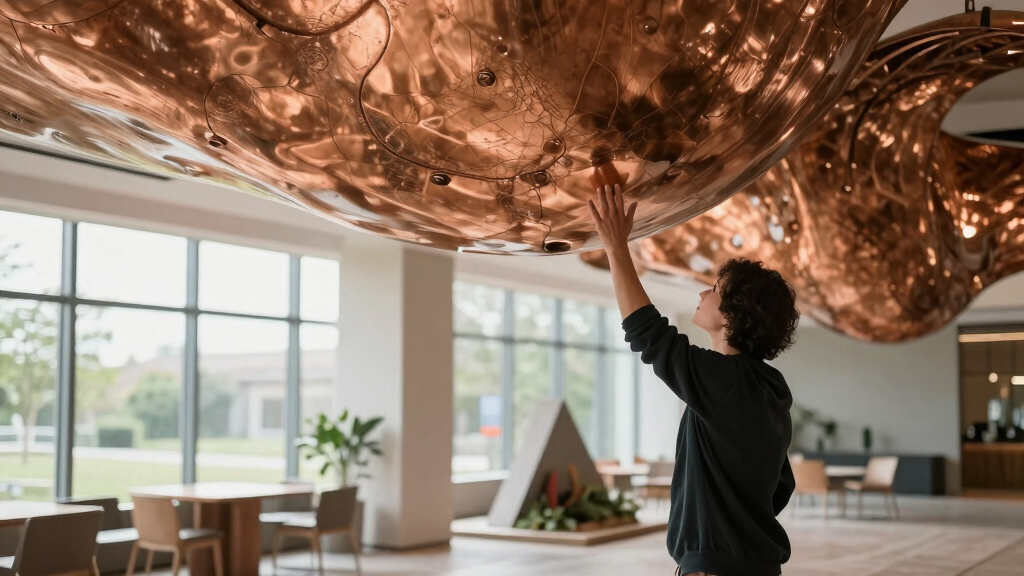
Located along Haramachida Odori in Machida, Hatmachida is designed as a ‘micro-landmark’ that blurs the boundaries between street, building, and plaza. Its defining feature is an eight-meter-high copper canopy, crafted using traditional ichimonji-buki standing-seam technique, which develops a natural patina over time. The canopy provides shelter and visual prominence within the streetscape, while its surface reflects environmental aging, adding a temporal dimension to the structure.
Underneath the canopy, the pavilion contains 2,923 shaped plywood panels forming the ceiling, assembled through digital fabrication and manual craftsmanship. The ground level hosts six counters supporting functions such as information, takeout, retail, and informal gathering. Integrated lighting enhances visibility at night, turning the structure into a landmark. The project was developed through social experiments conducted in 2021 and 2022, testing various spatial configurations and community uses, which informed its final design.
Designed to serve as a civic platform, Hatmachida supports activities like community meetings, small markets, and local events. It is part of a broader strategy to activate public space along Haramachida Odori, with potential future expansion to similar hubs across the district, linking local destinations and supporting local businesses beyond the physical site.
Impact of the Copper Canopy on Urban Public Space
The project demonstrates how a small-scale architectural intervention can reshape urban streetscapes, fostering community engagement and local commerce in transit-oriented areas. The copper canopy’s distinctive design and evolving patina make the structure a visual landmark that enhances the identity of the neighborhood. This approach offers a model for cities seeking to integrate civic functions into busy streets, supporting social interaction and urban vitality without large-scale development.
By blending architecture, public space, and community programming, Hatmachida exemplifies innovative civic infrastructure that responds to contemporary urban needs. Its success could influence future projects aiming to transform underused streets into active civic corridors, contributing to broader urban renewal efforts.
As an affiliate, we earn on qualifying purchases.
Urban Transformation and Civic Design in Tokyo Suburbs
Haramachida Odori is a major boulevard in Machida, a commuter city west of Tokyo, originally designed primarily for automobile traffic. Historically, the street has limited pedestrian engagement due to its scale and function. The project emerged from social experiments in 2021 and 2022, which explored ways to activate such transit-oriented streets through small interventions.
Nikken Sekkei’s design builds on the presence of a long-standing police box, transforming part of the boulevard into a space for gathering and interaction rather than just transit. The project aligns with broader efforts in Tokyo suburbs to enhance walkability and civic life by creating flexible, community-oriented public spaces that can evolve over time.
“The copper canopy is designed to develop a natural patina, symbolizing the passage of time and environmental change, making the structure a living part of the cityscape.”
— Nikken Sekkei design team
Unclear Future Expansion and Long-term Use
It is not yet confirmed how widely the project will be replicated across Machida or other districts. The long-term impact on local commerce and community engagement remains to be evaluated as the hub begins operation and gathers user feedback. Details about potential future sites and the project’s evolving role are still under development.
Next Steps for Civic Activation and Monitoring
The project team plans to monitor the hub’s usage over the coming months and gather community feedback to refine its functions. Discussions about replicating similar hubs in other parts of Machida and beyond are ongoing, with potential expansion contingent on initial success. The hub’s role in fostering ongoing civic activities and its influence on urban design strategies will be key areas to observe.
Key Questions
What is the purpose of the copper canopy in the community hub?
The copper canopy serves as a visual landmark, providing shelter and defining the civic space. Its evolving patina also symbolizes environmental change and the passage of time, integrating material aging into urban identity.
How does Hatmachida support local community activities?
The hub incorporates functions like information dissemination, small retail, takeout food, and informal gathering spaces, encouraging community interaction and supporting local businesses.
Is this project part of a larger urban renewal plan?
Yes, it is conceived as the first element in a broader strategy to activate public space along Haramachida Odori, with potential future hubs planned to connect neighborhoods and enhance civic life.
What materials were used in the construction of the canopy?
The canopy was built using traditional ichimonji-buki standing-seam copper techniques, and the ceiling features 2,923 plywood panels assembled with digital and manual methods.
When was the community hub completed and opened?
The project was completed and opened in 2024.
Source: designboom
Fall Picks
fall essentials
As an affiliate, we earn on qualifying purchases.