Improper speaker placement can cause uneven sound, echoes, and muddiness, ruining your listening experience. To avoid this, guarantee your speakers are at ear level, spaced 6-12 feet apart in an equilateral triangle with your seat, and placed away from walls or corners. Properly calibrate and use acoustic treatments to minimize reflections. If you want to learn more about optimizing your setup, keep exploring for detailed tips to transform your sound.

Get furniture and decor delivered free with Prime
- Fast, free delivery on millions of items
- Prime Video, Amazon Music and more included
- Member-only deals all year
Key Takeaways
- Incorrect speaker spacing and positioning can cause unbalanced sound and poor stereo imaging.
- Ignoring room acoustics and reflections leads to echoes, muddiness, and reduced clarity.
- Placing speakers too close to walls or corners results in boomy bass and sound distortion.
- Failing to calibrate and angle speakers properly diminishes soundstage and focus.
- Neglecting acoustic treatments like panels and curtains allows sound reflections and reduces audio quality.
bookshelf speakers for living room
As an affiliate, we earn on qualifying purchases.
As an affiliate, we earn on qualifying purchases.
Why Proper Speaker Placement Boosts Your Sound Quality
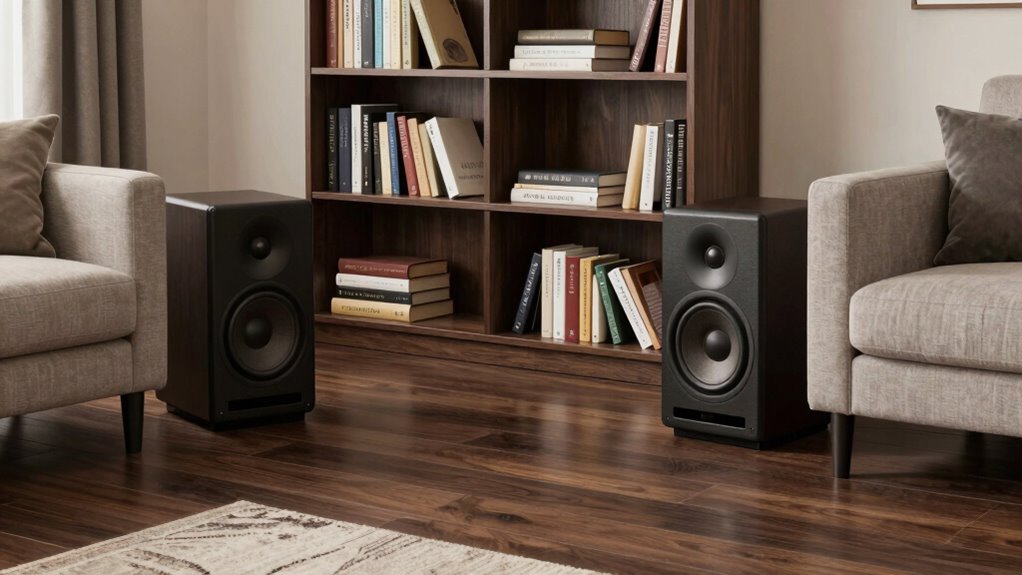
Have you ever wondered why some audio setups sound noticeably better than others? Proper speaker placement is key. When you position your speakers correctly, it enhances the overall sound quality and creates a more immersive experience. Speaker calibration guarantees your audio system is optimized, balancing volume and tone for the best output. Good cable management also plays a crucial role by preventing tangles and interference, which can degrade sound clarity. When cables are neatly organized, you avoid accidental disconnections and reduce static noise. Correct placement makes sure sound waves reach your ears evenly, improving clarity and stereo imaging. Proper speaker calibration ensures your system is finely tuned to your space and preferences. Investing time in these details amplifies your listening experience, making your speakers perform at their best. Ultimately, thoughtful placement, calibration, and cable management work together to elevate your sound quality considerably.
Common Mistakes When Positioning Speakers in Your Living Room
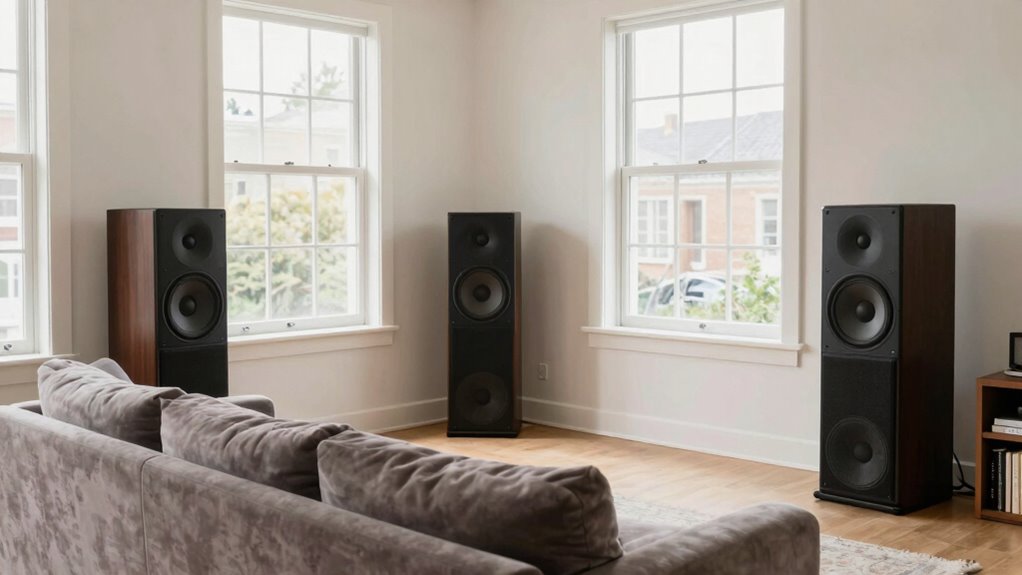
One common mistake is not spacing your speakers properly, which can lead to uneven sound. Ignoring acoustic treatments also hurts your audio experience by causing unwanted echoes and dead spots. Addressing these issues can markedly improve your overall sound quality, especially when integrating energy-efficient cloud solutions that prioritize optimal performance and sustainability.
Improper Speaker Spacing
When speakers are positioned too close together or too far apart, the soundstage can become unbalanced, leading to poor audio quality and a less immersive experience. Proper speaker spacing guarantees a cohesive and natural sound. Keep in mind that speaker height and speaker angle considerably influence the listening experience; aligning speakers at ear level and angling them toward your listening position enhances clarity. Incorrect spacing can cause phase issues and distort stereo imaging. To optimize placement:
- Guarantee speakers are equidistant from your primary listening spot.
- Maintain a distance of about 1.5 to 2.5 meters between speakers.
- Adjust speaker angle to direct sound toward your ears.
- Position speakers at the appropriate height, ideally at ear level when seated.
- Considering speaker technology can further improve sound quality and ensure a more accurate soundstage.
Proper spacing creates a balanced soundstage, maximizing your home theater’s potential.
Ignoring Acoustic Treatments
Ignoring acoustic treatments can markedly compromise your home theater’s sound quality, even if your speaker placement is perfect. Without proper acoustic treatments, reflections and echoes distort sound clarity, making dialogue less intelligible and music less immersive. Acoustic treatments, like diffusers and absorbers, help control sound reflections and improve clarity. Additionally, soundproofing is essential to prevent external noise from interfering with your listening experience. Neglecting these elements leaves your room acoustically untreated, causing uneven sound distribution and muddiness. Proper room acoustics management ensures your speakers perform at their best and your listening environment remains balanced. Investing in acoustic treatments and soundproofing creates a balanced environment where your speakers perform at their most effective. Remember, good speaker placement isn’t enough—addressing room acoustics is crucial for achieving true high-fidelity audio in your living room.
How to Find the Best Listening Spot for Your Speakers

Finding the perfect listening spot for your speakers can greatly enhance your audio experience. Start by placing your seat where sound is balanced and clear. To optimize this, consider the following:
- Perform speaker calibration regularly to ensure accurate sound reproduction.
- Keep cables organized to prevent interference and maintain a clean setup.
- Avoid placing speakers directly against walls to reduce bass muddiness.
- Experiment with the distance between speakers and your listening position for stereo imaging.
- Remember that understanding luxury audio equipment can help you select high-quality speakers that deliver superior sound.
A well-chosen spot improves soundstage and clarity. Remember, small adjustments in placement can make a big difference. Proper cable management not only enhances aesthetics but also prevents signal disruption. By fine-tuning your listening spot, you set a foundation for an immersive audio experience that’s worth the effort.
How to Space and Position Your Speakers for Optimal Sound
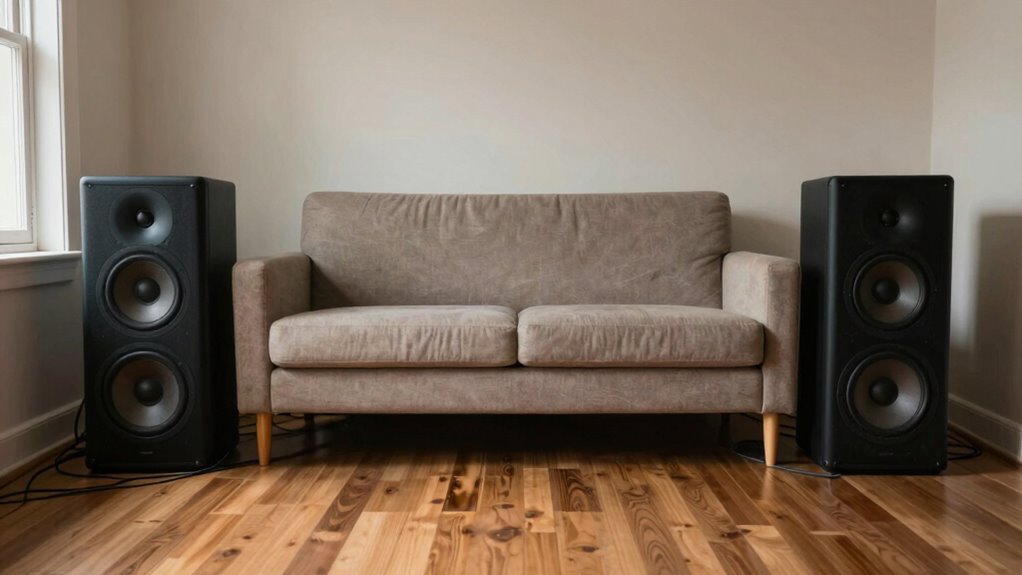
Ever wondered how the right spacing and positioning of your speakers can transform your listening experience? Proper speaker placement enhances sound staging, making your audio feel more immersive and natural. Start by spacing your speakers roughly 6 to 12 feet apart, forming an equilateral triangle with your listening spot. This setup ensures balanced sound dispersion. Use speaker calibration tools or settings to fine-tune the system, correcting any imbalances. Keep your speakers slightly angled inward toward your listening position for better focus. Avoid placing speakers too close to walls, which can muddy the sound. Additionally, understanding audio calibration techniques can help optimize your setup further. By carefully spacing and positioning your speakers, you create a more precise sound stage that brings clarity and depth to your music or movies, elevating your overall listening experience.
Why Ear-Level Speaker Height Makes a Difference

Setting your speakers at ear level makes a noticeable difference in sound clarity and imaging. When your speaker height aligns with your ears, you’ll experience a more accurate and immersive audio experience. Proper ear-level placement ensures sound waves reach you directly, reducing distortion and echo. Additionally, it helps with stereo imaging, so instruments and voices sound precisely positioned. Consider these factors:
- Minimizes sound reflection off furniture or surfaces
- Enhances high-frequency clarity
- Improves stereo and surround sound accuracy
- Ensures consistent sound quality regardless of seating position
- Speaker placement directly impacts overall sound quality and listening enjoyment.
Adjusting your speaker height to ear level isn’t just about aesthetics; it’s critical for ideal sound performance. By paying attention to speaker height, you’ll enjoy a richer, more detailed listening experience every time.
How Room Layout and Furniture Affect Your Speaker Setup
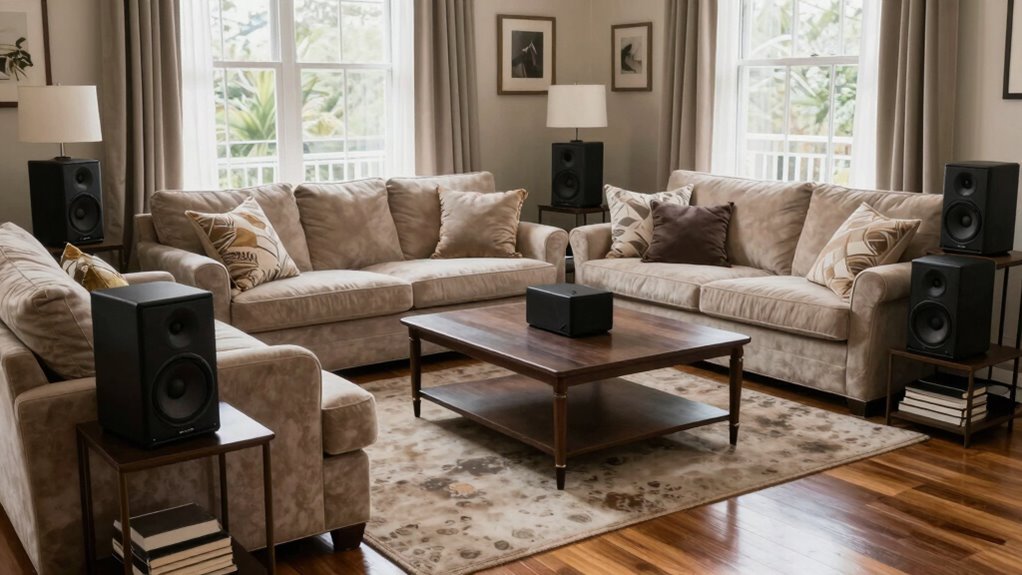
While placing your speakers at ear level improves sound clarity, the room layout and furniture arrangement can considerably influence how that sound behaves. Your furniture arrangement affects sound reflection and absorption, shaping the overall listening experience. Large or bulky furniture can block or diffuse sound waves, causing uneven audio. Additionally, room dimensions play a critical role; small or irregularly shaped rooms can create unwanted echoes or dead spots. To optimize sound quality, arrange furniture to avoid obstructing speaker paths and maintain symmetry around your listening area. Keep open spaces between speakers and furniture to promote balanced sound dispersion. Proper room acoustic treatment can further enhance sound quality by controlling reflections and reverberations. By paying attention to your room’s layout and dimensions, you’ll enhance clarity and ensure your speakers perform at their best.
Tips to Minimize Sound Reflections and Echoes in Your Room

To reduce sound reflections and echoes in your room, start by adding absorptive materials like rugs, curtains, or foam panels. Next, adjust your speaker placement to avoid bouncing sound waves off walls and furniture. These simple steps can considerably improve your room’s acoustics and listening experience. Additionally, arranging furniture to break up open spaces can further help minimize sound reflections and create a more balanced sound environment.
Use Absorptive Materials
Have you ever noticed how echoes can make a room feel noisy or uncomfortable? Using absorptive materials helps tame these reflections, creating a clearer, more more enjoyable sound environment. Incorporate items like soundproof curtains and acoustic panels to absorb excess sound waves. These materials effectively reduce reverberation and improve audio clarity. Consider placing acoustic panels on key reflection points, such as walls behind your speakers or along the ceiling. Soundproof curtains can be hung over windows or open spaces to prevent sound leakage and echo. These small adjustments make a significant difference in how your audio system performs and how comfortable your room feels. By strategically using absorptive materials, you’ll enjoy a richer, more immersive listening experience without unwanted echoes or reflections. Material placement can further optimize sound absorption for the best listening experience.
Optimize Speaker Placement
Proper speaker placement plays a vital role in reducing sound reflections and echoes that can cloud your audio. To achieve this, start with accurate speaker calibration, ensuring each speaker delivers balanced sound. Position your speakers slightly away from walls and corners to prevent direct reflections that cause echoes. Use acoustic panels strategically on walls to absorb unwanted sound waves, further minimizing reflections. Keep speakers at ear level and form an ideal triangle with your listening position, which helps create a focused soundstage. Experiment with slight adjustments in placement and use your calibration tools to fine-tune audio performance. Properly positioning your speakers and adding acoustic treatments will greatly enhance clarity and reduce echo, providing a cleaner, more immersive listening experience.
Should You Use Speaker Stands or Wall Mounts? Pros and Cons

Choosing between speaker stands and wall mounts depends on your space, aesthetic preferences, and audio goals. Speaker stands offer flexibility in positioning, allowing you to fine-tune height and placement for ideal sound. They also prevent wall damage but may occupy floor space. Wall mounts save space, create a sleek look, and keep speakers out of the way, ideal for smaller rooms. However, they are less adjustable once installed and can be challenging to reposition. Consider the following:
Choosing between stands and wall mounts depends on room space, aesthetic, and adjustability needs.
- Ease of adjustment and repositioning
- Impact on room decor and aesthetics
- Space constraints and room size
- Potential wall damage or mounting difficulty
Ultimately, your decision hinges on balancing flexibility with visual appeal to achieve the best sound experience in your living room.
Troubleshooting Your Speaker Setup When Sound Isn’t Right
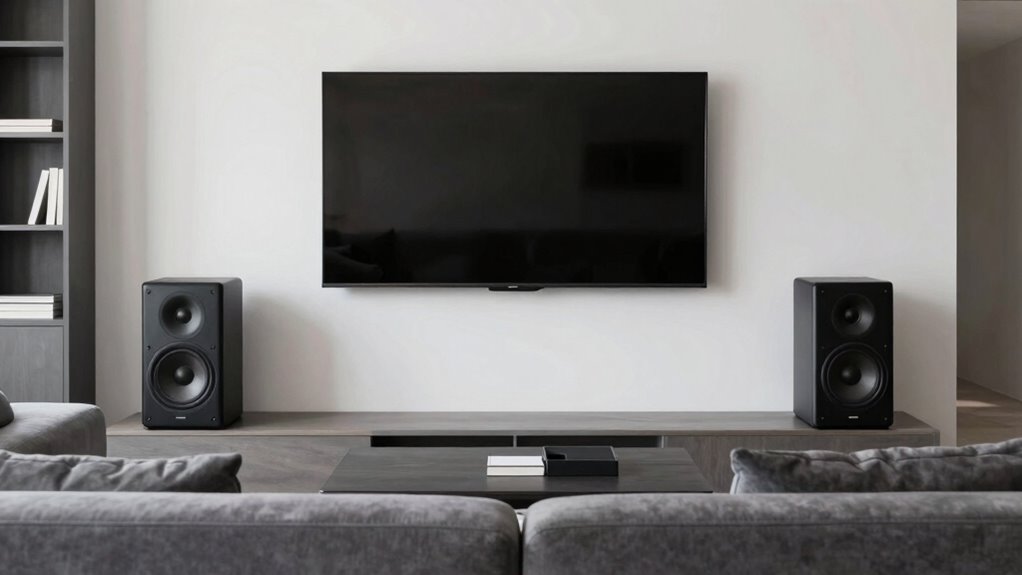
Even with carefully selected speaker stands or wall mounts, sound issues can still arise that disrupt your listening experience. The first step is to check your speaker calibration; verify your speakers are properly balanced and positioned for ideal sound. Incorrect calibration can cause uneven audio or muddiness. Next, review your cable management—loose or tangled cables can introduce interference or disrupt signal flow. Organize cables neatly, avoid crossing power cords with audio cables, and confirm connections are secure. If sound still isn’t right, try adjusting speaker angles and distances, then re-calibrate your system. Proper calibration and tidy cable management are essential to resolving most sound issues and achieving clear, balanced audio in your living room setup.
Frequently Asked Questions
How Do I Adjust Speaker Placement for Different Room Sizes?
To adjust speaker placement for different room sizes, start by setting the speaker height so that tweeters are at ear level when seated. Then, angle the speakers toward your listening position using the speaker angle to create a focused soundstage. In smaller rooms, keep speakers closer but not too close to walls, while larger rooms benefit from wider spacing and proper angling to fill the space evenly.
What Are the Signs of Poor Speaker Positioning?
You notice the sound feels off—perhaps muffled, unbalanced, or lacking clarity. That’s a clear sign of poor speaker positioning. Check if your speakers are at the right height; they should be ear level when seated. Also, verify they’re symmetrical and aimed toward your listening position. When these elements are off, your audio suffers, robbing you of the immersive experience you deserve.
Can Furniture Placement Improve Sound Quality?
Yes, furniture placement can improve sound quality. Position your furniture to avoid blocking the woofer and create space for proper sound diffusion. Keep large pieces away from speakers and use soundproofing techniques like rugs and curtains to reduce echo. Properly arranging furniture ensures clearer audio, better bass response, and a more immersive experience. Experiment with placements to find the *best* setup that complements your speaker positioning for the *ideal* sound.
How Do I Prevent Speaker Vibrations From Affecting Sound?
Think of your speakers as delicate dancers on a shaky stage. To keep their performance smooth, you need speaker isolation and vibration damping. Place them on sturdy stands or pads to prevent vibrations from traveling and disrupting sound clarity. Adding rubber or foam under the speakers absorbs unwanted movement. By doing so, you guarantee vibrations stay isolated, allowing your speakers to deliver pure, crisp sound without interference.
Is It Better to Calibrate Speakers Manually or With Software?
You should choose software tuning for calibration because it offers precise, consistent results, making it easier to optimize your speakers. While manual calibration allows you to tailor settings personally, it can be less accurate if you’re not experienced. Using software tuning simplifies the process, often providing automatic room correction and equalization, which helps improve sound quality without the guesswork. For the best results, combine both methods if possible.
Conclusion
Did you know that improper speaker placement can reduce your sound quality by up to 50%? By following these tips, you’ll enjoy richer, clearer audio in your living room. Remember, the right positioning not only boosts your listening experience but also makes your space more enjoyable. Take the time to fine-tune your setup—you’ll notice the difference instantly, making every movie night and music session even better. Your perfect sound is just a few adjustments away!
Halloween Picks
halloween
As an affiliate, we earn on qualifying purchases.