Open a free Amazon Business account
Business pricing, bulk buying and tax-exempt orders.
As an affiliate, we earn on qualifying purchases.
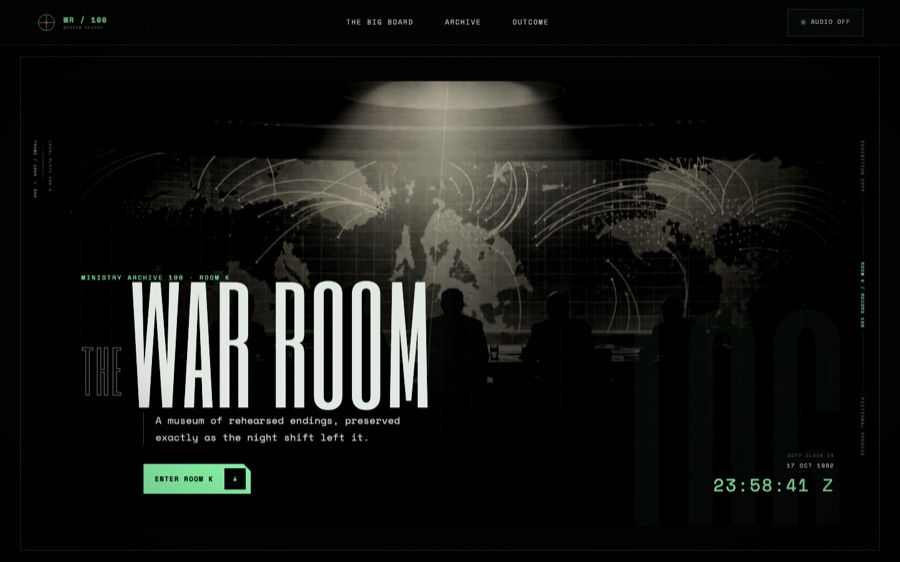
Unveiling the War Room: A Museum-Style Digital Archive with a Signature State Machine
Imagine stepping into a cinematic, war-room-inspired digital space that feels like a memorial rather than a typical interactive exhibit. This AI-constructed experience centers around a singular, impactful machine—a meticulously engineered archive that guides visitors through a layered narrative of conflict and memory. Its hallmark feature is a sophisticated, scroll-driven state machine that dynamically orchestrates multiple visual and auditory systems simultaneously, creating an immersive, cohesive environment. The design balances stark minimalism with cinematic tension, offering an experience that is both contemplative and striking.
The 3-Pass Build & Critique Pipeline
The development process begins with an initial build phase where the core visual systems—SVG maps, route animations, and interactive controls—are assembled based on a comprehensive guide. The second phase involves rigorous critique, where each element is examined for coherence, accessibility, and emotional impact, ensuring the experience remains compelling yet restrained. Finally, the art director reviews and certifies the design, balancing technical precision with narrative intent, all while adhering to the guiding principles of minimalism and cinematic tension. This iterative process guarantees a refined, purposeful experience grounded in thoughtful critique and expert oversight.
The full build notes live in the room’s design guide.
Design Palette and Signature Interaction
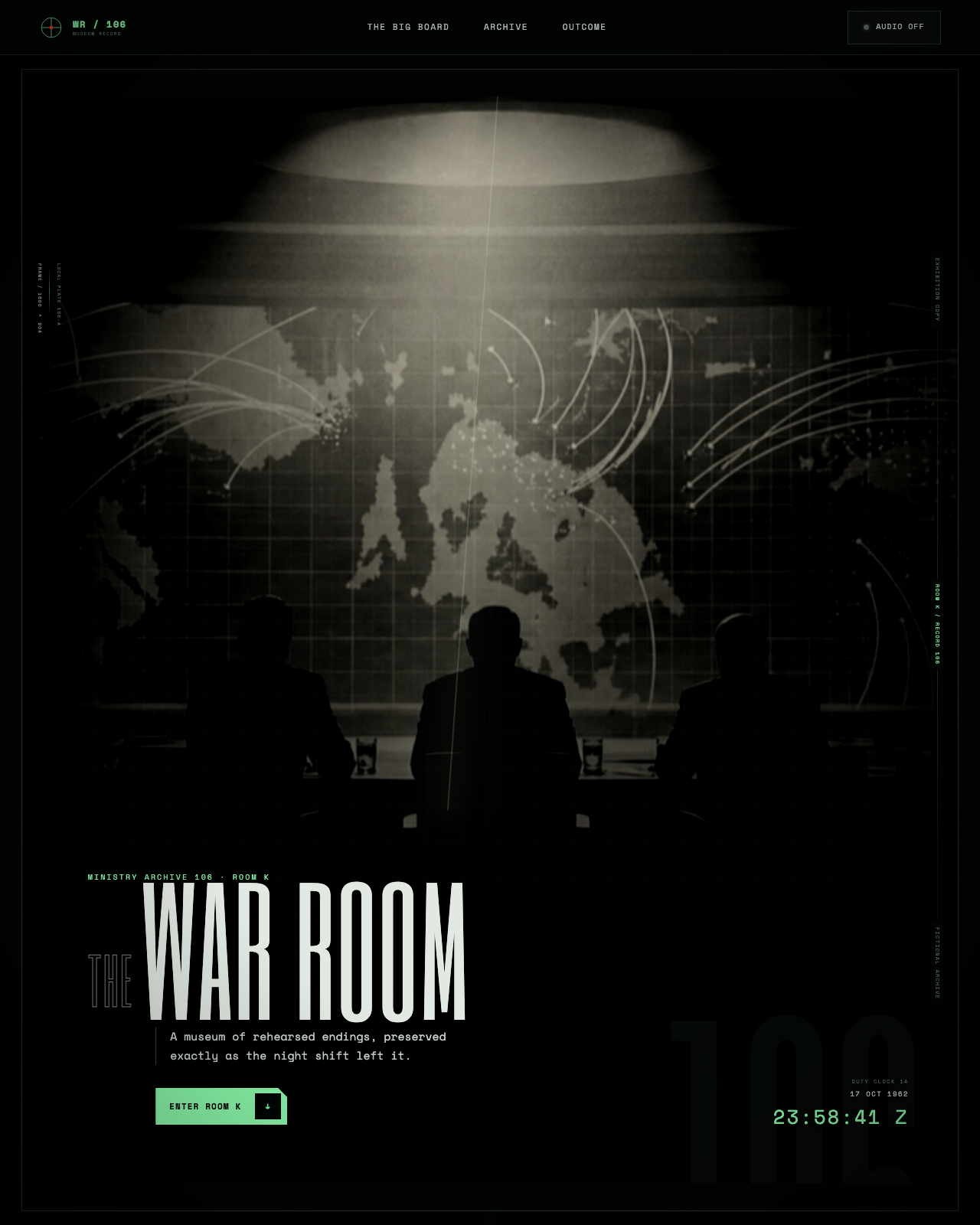
The visual language employs a restrained palette dominated by dark, matte materials paired with contrasting highlights, such as a vivid red object color. Typography is handled with a monospace typeface, emphasizing clarity and a technological aesthetic, complemented by angular, steel-like edges and compact labels that evoke a cataloged, militaristic feel. The centerpiece—a vector graphic SVG map—is crafted with accessible, code-generated elements, featuring simplified continent outlines and animated routes achieved through CSS stroke-dasharray animations controlled via JavaScript. The core interaction revolves around a scroll-linked state machine that synchronizes visual cues, such as a dynamically moving needle on the DEFCON dial, animated route traffic, and real-time updates to contact points. This system ensures a seamless experience, where multiple visual layers respond harmoniously as users navigate through the narrative. Additionally, optional synthesized audio enhances immersion, triggered only upon user activation, ensuring accessibility and performance are maintained.
Want this? Paste this into your AI coding agent
Build a single-page showcase website from this art-direction brief. Work like an elite creative frontend engineer; commit totally to the direction.
BRIEF (room 106 of 175, “warroom”):
THE WAR ROOM — a Cold-War command bunker, museum framing (fiction). Aesthetic: Kubrick war room; the big board in the dark. Palette: void black, map-table green glow, DEFCON ladder colors, red phone. Fonts: six-caps (towering display), space-mono (teletype). SIGNATURE: THE BIG BOARD — a wall-size world map (SVG) with great-circle arcs drawing and blinking contact points, sweeping like the OPS normal cycle; a DEFCON dial that the scroll narrative moves 5→1 (lighting and pace intensify each step); teletype messages hammer out (per-char with bell). The red phone rings once (visual tremble) at DEFCON 2. Museum plaques explain the era coldly; the final section de-escalates back to 5 with the line “The best ending is the boring one.” Unforgettable: the board coming alive at DEFCON 2.STACK: pure HTML/CSS/JS, no build step, no frameworks, no CDNs or external requests of any kind; self-hosted fonts only; every visual is code (CSS/SVG/canvas/WebGL) — no image assets required.
QUALITY BAR: flawless at 390px, 834px and 1440px with zero horizontal overflow; tap targets >= 44px; semantic landmarks, focus-visible styles, body-text contrast >= 4.5:1; prefers-reduced-motion pauses or simplifies heavy animation; rAF loops pause when the tab is hidden; hold 60fps (cap particle counts, avoid layout thrash); rich invented content everywhere — real-sounding names, numbers and program notes, never lorem ipsum; orchestrate one beautiful staggered load moment plus scroll and hover surprises. FORBIDDEN: Inter/Roboto/Arial/system-ui, purple-gradient-on-white, and cookie-cutter hero+cards+footer layouts.
PROCESS: iterate in three documented passes — (1) build plus builder self-critique, (2) merciless external critique finding and fixing at least ten real problems, (3) art-director elevation from good to unforgettable. Screenshot at all three widths every pass and fix everything you can see.
— Original brief by Claude Fable 5 (art director), executed by the FABLE/175 pipeline.
— This room lives at https://fable-25-830.netlify.app/sites/warroom/
This is the verbatim art-direction brief that produced the room — exposed by the exhibition itself via the “Prompt” link in the room’s footer.
Explore the Experience & Discover More
Visit the live exhibition to immerse yourself in this AI-crafted museum space, and browse all 175 archive sites at the central hub to witness the full scope of this digital memorial series. Each site offers a unique window into the machine-driven narrative craftsmanship that defines this project.
Visit the live room → · Browse all 175 rooms
Previously in Wing V
- Room 102: Flight Deck 0300 — A Night-Launch Documentary
- Room 101: Ghost Division — The Complete Motion Picture Archive
- Room 104: Silent Running — Beneath the White Sea
FABLE / 175 is a finished exhibition of 175 fundamentally different websites, each built end-to-end by an AI. This article is part of our series walking through it room by room.
scroll-controlled interactive display
As an affiliate, we earn on qualifying purchases.
As an affiliate, we earn on qualifying purchases.
Fall Picks
fall essentials
As an affiliate, we earn on qualifying purchases.